Eleven days. That is how long NVIDIA went without Jensen Huang. He resigned as president and CEO on November 12, and on November 23 the board reinstated him.
Those eleven days put two questions on the table for every AI team. Do we need a plan B for NVIDIA hardware? And what happens to open-source AI models if their most powerful backer is gone?
We think the second question was the more important one. The hardware barely moved. But Huang has been one of the biggest advocates for open models at a very geopolitically tense time, and a growing share of companies now build on them. Our takeaway: NVIDIA remains the right hardware choice, and the smarter hedge is to control your own models and the infrastructure they run on.
Key takeaways
- NVIDIA kept executing. During the gap it reported $115.8 billion in quarterly revenue and confirmed Vera Rubin NVL72 had shipped.
- Alternatives are real but small. IDC estimates NVIDIA holds more than 80% of 2026 datacenter accelerated server revenue, with AMD in the low single digits.
- Open models were the real exposure. Huang’s exit put NVIDIA’s $12.9 billion Hugging Face acquisition and its Nemotron open models in question until the interim CEO confirmed both.
- Enterprises were already moving to open models. 42% ran open-weight models in production in September 2026, up from 31% in July, according to Futurum.
- Open is not free. Self-hosting costs now hold up half of open model pilots. Sizing the infrastructure correctly decides whether it pays off.
What changed at NVIDIA while Jensen Huang was away?
Operationally, very little. On November 17, under interim CEO Colette Kress, NVIDIA reported revenue of $115.8 billion, up 103% from a year earlier, and said Vera Rubin NVL72 was shipping in what it called the fastest product ramp in its history. Kress described the roadmap as on track.
On the same call she reaffirmed NVIDIA’s open source AI strategy and said the Hugging Face deal was still on track. So the products, the roadmap and the open model plans all held without the founder in the building. That is useful information for anyone planning a multi-year infrastructure purchase.
Are there real alternatives to NVIDIA GPUs in 2026?
Yes, more than at any point in the last three years, but none of them is a drop-in replacement for most enterprise teams. Here is where each one stands.
Sources: Jon Peddie Research, Semafor, IEEE ComSoc Technology Blog.
The market share numbers put this in proportion. IDC estimates that NVIDIA holds more than 80% of 2026 datacenter accelerated server revenue and AMD holds a low single-digit share. IDC expects competitors to gain by winning new spending in a growing market, and it does not expect them to displace installed NVIDIA systems.
Buyers did notice the moment. Judson Althoff, who runs Microsoft’s commercial business, told Bloomberg that “model diversity and silicon diversity will rule the day.” He also said most customers were “waiting for the dust to settle.”
IDC’s advice to enterprise buyers was direct: do not change plans on this news alone, get allocation and lead times in writing, and add an alternative platform to your qualification plan. We agree with all three. We deploy NVIDIA systems because that is where the software, the support and the supply chain are most mature today. If you run at a scale where a second source makes sense, inference on open models is the place to test it, because serving engines such as vLLM now run on AMD’s ROCm stack as well as on CUDA.
Why did Jensen Huang’s exit matter so much for open source AI models?
Because he was their most powerful backer in the United States, both commercially and politically. NVIDIA under Huang built the Nemotron family of open-weight models and agreed in September to buy Hugging Face for $12.9 billion. Hugging Face hosts more than 3 million models and is used by more than 18 million developers and 200,000 companies.
He also argued the case in public. In July he told Axios that “open-source models that are excellent should be used,” and he led an open letter from 25 technology companies asking Washington not to over-restrict open-weight models.
So when he resigned, the questions came quickly. TechCrunch reported that his exit put NVIDIA’s support for open source in question. The Financial Times reported that his departure could weaken the open model ecosystem and strengthen closed-model developers such as OpenAI and Anthropic. Hugging Face CEO Clément Delangue wrote that his company would “keep fighting for open-source AI, harder than ever.” MIT Technology Review covered a petition for Huang’s return that passed 115,000 signatures, including leaders from Hugging Face and major venture firms.
His return made the same point. NVIDIA’s board said its decision came after “input from senior levels of the United States government,” as NBC News reported. Reuters reported, citing people familiar with the matter, that President Trump and Vice President Vance personally intervened because they saw Huang as the one person protecting American-made open-weight AI models. If that account is accurate, open models were a central part of how the leadership question at the world’s most valuable chip company was settled.
It is easy to see why closed-model companies and open models are in tension. Open models turn the model itself into something close to a commodity. On Vercel’s AI Gateway in August 2026, open-weight models handled 56% of token volume but only 14% of estimated spending, according to Futurum. A lot of work is being done for comparatively little money. That is good for buyers and uncomfortable for anyone selling tokens at a premium.
Huang’s own position was more balanced than the headlines suggest. “We love closed models,” he said in early November. “There’s a solid place in the world for closed frontier models.” His argument was that the world needs both. We think that is right, and it is how most of the teams we talk to actually work.
Did the exit and return change how organizations think about open models?
It is too early for adoption data to show an effect, and we will not pretend otherwise. What we can say is that the trend was strong before the news and nothing in the eleven days slowed it.
Futurum’s September 2026 survey found 42% of enterprises running open-weight models in production, up from 31% just two months earlier. Those production users expect open models to carry 41% of their AI tokens within a year. On NVIDIA’s earnings call, Kress cited a 35-fold year-over-year surge in weekly open model token volume on OpenRouter.
Here is our read of what did change. Before November, choosing open models was mostly a cost and customization decision made by developers. The eleven days made it a resilience question for leadership: what is our plan if the company behind our model, or the champion behind our ecosystem, changes overnight?
An API contract does not answer that. A model whose weights you hold, running on infrastructure you control, does. Once you have downloaded the weights, no leadership change, acquisition or pricing decision can take the model away from you. That is the strongest argument for open models, and November made it concrete.
Where those models run matters too. Among Futurum’s production users, 46% host open models in self-managed cloud and 42% on their own premises. Only 29% rely on a hyperscaler’s native inference service.
What is the catch with open models?
The catch is the infrastructure. Futurum reports that self-hosting costs now hold up 50% of open model pilots, up from 40%, and that in-house builds report sustained return on investment less often than external solutions.
We see the same pattern, and it usually comes down to sizing. As our Infrastructure Lead Josh Gelata wrote in When Open Models Beat the API, DeepSeek V4-Pro needs about 862 GB of GPU memory for its weights, while Qwen3.6 fits on a single GPU. Buying a cluster for a workload that needed one node is one of the most expensive mistakes in self-hosting. Another is leaving that hardware idle for 16 hours a day.
Open models pay off when three things are true: the model is the smallest one that clears your accuracy bar, someone owns the serving layer, and the hardware stays busy.
What should AI teams do now?
1. Keep your NVIDIA plan, and get it in writing. Confirm allocation, lead times and support terms. Nothing in the last two weeks changed the roadmap.
2. Make your models portable. Build on a standard serving stack so you can swap one model for another without rebuilding. Use closed models where they are clearly better, and open models for high-volume work.
3. Own the layer that does not change. Models will keep changing every few months. The GPUs, networking and operations underneath them are a multi-year decision. Get that layer right and you can run whichever model wins.
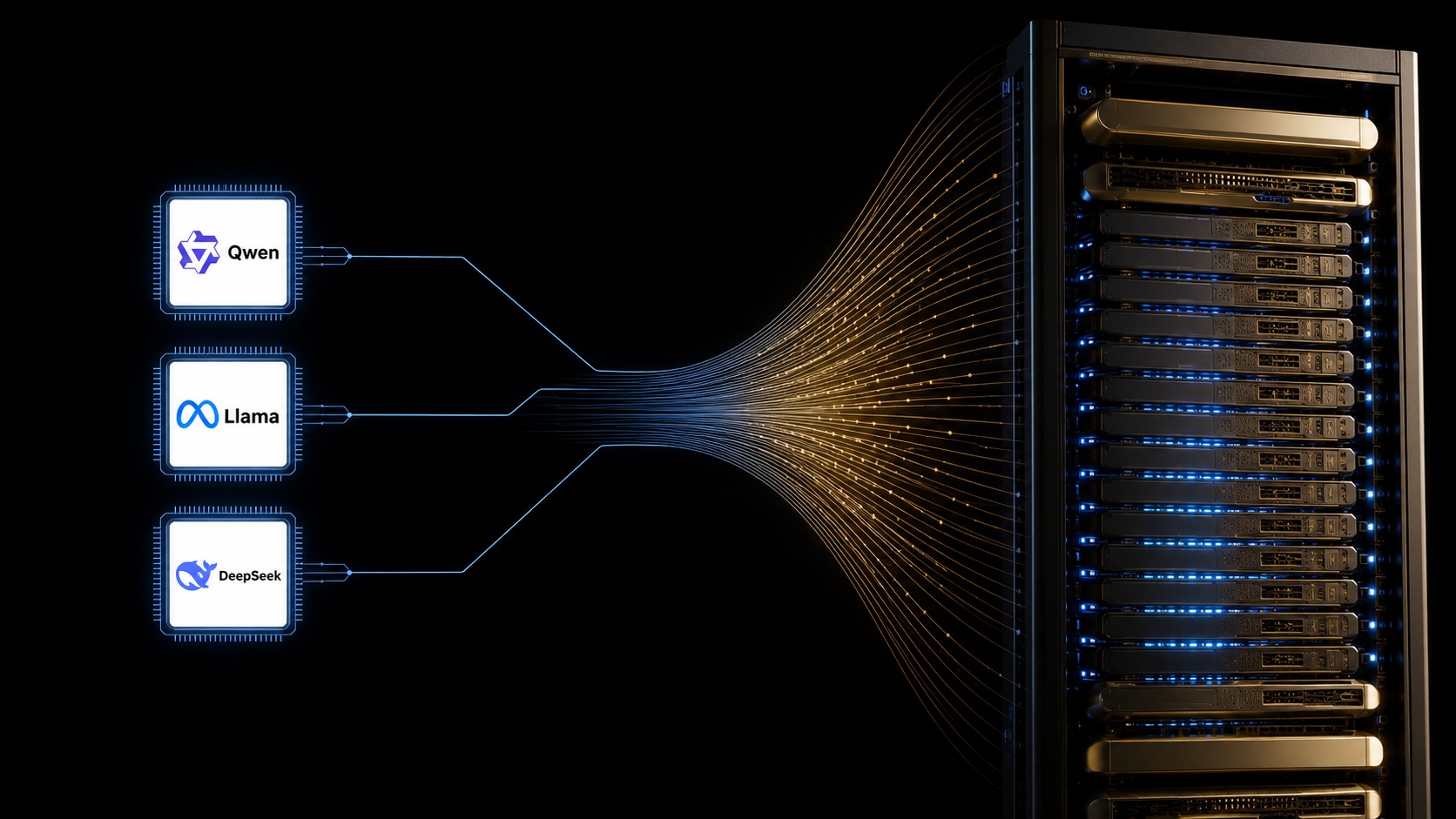
That third point is where Arc Compute comes in. We plan, source, deploy and operate NVIDIA GPU infrastructure for any model you choose to run, whether that is Nemotron, Llama, Qwen, DeepSeek or your own fine-tune. We build everything from single GPU servers to turnkey GPU clusters and private AI cloud. If you are working out what your open model strategy needs underneath it, talk to a GPU expert. Bring your token volumes and we will size it with you.
Frequently asked questions
Is Jensen Huang still the CEO of NVIDIA?
Yes. He resigned on November 12, 2026, and NVIDIA’s board reinstated him as president, CEO and a director on November 23, 2026. CFO Colette Kress served as interim CEO in between.
Is NVIDIA still acquiring Hugging Face?
As of NVIDIA’s November 17 earnings call, yes. The $12.9 billion deal was announced in September 2026 and has not closed yet. NVIDIA has said Hugging Face will remain an open platform.
What is NVIDIA Nemotron?
Nemotron is NVIDIA’s family of open-weight models, built for reasoning and long-running agentic AI workloads. Because the weights are open, you can download and run them on your own infrastructure.
Can open source AI models run on hardware other than NVIDIA?
Often, yes. Popular serving engines such as vLLM support AMD GPUs through ROCm. Custom CUDA code is harder to move, so test your actual workload before committing.
Are open models good enough for enterprise use?
For many workloads, yes. Futurum found that low-complexity tasks make up 51% of enterprise open model usage. Closed frontier models generally still lead on the hardest reasoning tasks, which is why most teams end up using both.
Sources
NVIDIA, CEO transition announcement, November 12, 2026
CBS News, NVIDIA reinstates Jensen Huang as CEO, November 23, 2026
NVIDIA, financial results for third quarter fiscal 2027, November 17, 2026
TechCrunch, Jensen Huang’s exit puts Nvidia’s support for open source in question, November 12, 2026
TechCrunch, Nvidia says its open source AI strategy remains intact, November 17, 2026
TechCrunch, Hugging Face CEO vows to keep fighting for open source AI, November 12, 2026
Slashdot summary of the Financial Times, November 18, 2026
NBC News, Jensen Huang reinstated as Nvidia CEO, November 23, 2026
MIT Technology Review, The open-source movement wants Jensen Huang back, November 16, 2026
IDC, Jensen Huang Resigns From NVIDIA: What AI Infrastructure Buyers Should Watch, November 13, 2026
TipRanks summary of Bloomberg interview with Judson Althoff, November 2026
Jon Peddie Research, AMD widens MI400 family for Helios, November 16, 2026
Semafor, Nvidia CEO’s ouster leaves AI world reeling, November 12, 2026
IEEE ComSoc Technology Blog, competing AI chip suppliers, November 14, 2026
Yahoo Finance, Nvidia confirms acquisition of Hugging Face, September 3, 2026
Axios, Nvidia’s Jensen Huang defends Chinese AI, July 22, 2026
Mezha, Jensen Huang says Nvidia sees a place for both open and closed AI models, November 3, 2026
Futurum, Enterprises Embrace Open Weights but Infrastructure Sellers Profit Most, October 26, 2026
Arc Compute, When Open Models Beat the API, August 21, 2026