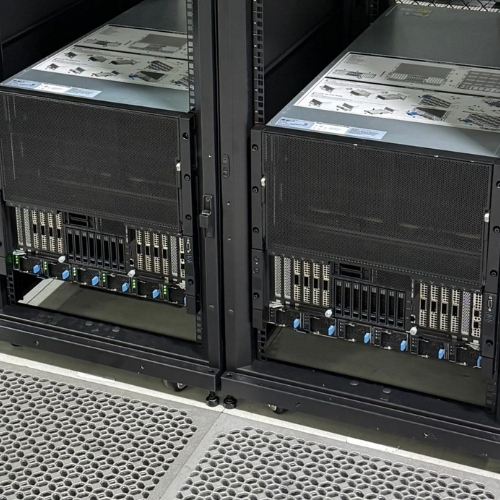
The convenient era of pasting work into a public chatbot and hoping for the best is closing. Across regulated industries, the question has moved from whether to use AI to how to deploy it on terms the business can defend. In most boardrooms that answer now has a name: private LLMs, models that run inside infrastructure the organization controls rather than behind a third party API.
The case for going private is usually built on three pressures: data exposure, rising cost, and tightening regulation. Each is real. But the part that decides whether a private deployment succeeds sits one layer down, in the infrastructure itself. According to Gartner, worldwide AI spending will reach $2.59 trillion in 2026, up 47% year over year, with infrastructure accounting for over 45% of that total. The money is following the hardware. The results follow how well that hardware is run. For a wider view of the move off public cloud, see our take on the rise of private AI cloud.

Why are enterprises moving to private LLMs in 2026?
Enterprises are moving to private LLMs to keep sensitive data inside their own perimeter, control cost as usage scales, and meet compliance obligations that public APIs cannot fully guarantee. McKinsey's2025 State of AI survey found 88% of organizations now use AI in at least one function, pushing these decisions from pilots into production infrastructure.
The adoption curve is no longer the story. The State of AI survey from McKinsey reported that 88% of organizations use AI in at least one business function, up from 78% a year earlier, yet only 39% report measurable earnings impact at the enterprise level. The gap between usage and return is where infrastructure choices start to matter. When models move from a few experiments to systems that touch customer records, clinical data, or trading signals every minute, the convenience of a public end point runs into the reality of governance, latency, and unit cost.
Three forces are doing most of the pushing:
- Data control. Every prompt sent to a public API leaves the building. For regulated data, that is a governance problem before it is a security one.
- Cost at scale. API pricing is comfortable in a pilot and punishing in production, where it rises with every token processed.
- Compliance. Auditability and data residency are turning into infrastructure requirements rather than policy statements.
Financial services firms, healthcare and life sciences organizations, and other data sensitive operators tend to move first, because their data is the part they cannot afford to hand to someone else.
The data exposure problem public APIs cannot fully solve
The privacy argument is often told as a story about employees pasting secrets into a chatbot, and that part is true. LayerX Security's 2025 enterprise report found that nearly 40% of files uploaded to generative AI tools contained personally identifiable or payment data, much of it through personal, unmanaged accounts outside any corporate control. That is the visible risk.
The less visible risk is structural. In June 2025, researchers at Aim Security disclosed a flaw they called EchoLeak, described as the first zero click vulnerability in a production enterprise AI assistant, Microsoft 365 Copilot, that could pull data out without any user action. Microsoft issued a fix before public disclosure and there was no sign of exploitation in the wild, but the lesson held: when your data passes through a system you do not operate, your exposure depends on someone else's patch cycle. Separately, reports in 2025 found that a public chatbot's sharing feature had let hundreds of thousands of user conversations be indexed by search engines, turning private exchanges into public records.
None of this makes public APIs reckless. It means that for the workloads where the data itself is the asset, keeping inference inside a controlled environment removes an entire category of exposure rather than managing it after the fact.
What does it actually cost to run a private LLM?
A private LLM is cheaper than a public API only at high, sustained usage. Below that point, idle hardware makes the per token cost worse, not better. The deciding factor is utilization: a GPU running near capacity can cost a fraction per token of the same GPU sitting mostly idle.
This is where the popular version of the private LLM story oversimplifies. Public APIs do get expensive at scale, because pricing rises in a straight line with every token, so a workload that grows tenfold sees its bill grow tenfold. Bringing inference in house swaps that variable cost for a largely fixed one. Independent analyses tracking inference pricing through 2025 estimate the cost of running models has fallen by roughly 10x per year as hardware and serving software improved, which has widened the set of workloads where owning compute pays off.
But fixed cost is only an advantage when the hardware is busy. The same analyses note that a GPU running at around 10% load can cost up to 10 times more per token than one running near capacity, because depreciation, power, and cooling are paid whether the chip is working or not. This is the quiet failure mode of private deployments: teams buy capacity, run it at a fraction of its potential, and conclude that on premises is expensive when the real problem was utilization.
The honest framing is a break even, not a slogan. Self hosting tends to win on total cost at high and predictable volume, while public APIs remain the rational choice for bursty, low volume, or experimental work. Most production estates land somewhere between, which is why hybrid architectures, with sensitive and steady workloads kept in house and spiky or exploratory ones sent to an API, have become a common operating model. We go deeper on this in our CEO's guide to AI inference economics.
Compliance is becoming an infrastructure requirement
Regulation has caught up with deployment. The GDPR and HIPAA already govern where regulated data can live and who can touch it. The European Union's AI Act has added a layer specific to models: obligations for General-Purpose AI (GPAI) providers became applicable on 2 August 2025, and the broader framework, including most high risk system rules and the Commission's enforcement powers, applies from 2 August 2026, according to the European Commission.
For an infrastructure lead, the operational translation is simpler than the legal text. Compliance increasingly means being able to prove where data was processed, who had access, and how the model behaved, on demand. That is far easier when inference runs inside infrastructure you control and audit than when it depends on a provider's attestations. Data residency, access logging, and isolation stop being checkboxes and become properties of the architecture itself. Our analysis of data sovereignty in AI covers why cloud only strategies fall short here.
The hidden variable is how well the infrastructure is run
Strip away the headlines and a private LLM program comes down to a handful of engineering decisions that rarely make it into a strategy deck. Choosing the right GPU for the workload. Sizing memory to the model rather than overbuying. Keeping the serving stack busy through batching and scheduling. Refreshing models without taking the service down. A 2026 study of production inference on current NVIDIA hardware put it plainly: building production grade systems takes real expertise in hardware selection, model optimization, and serving infrastructure, not just access to chips.
This is the same lesson behind the broader return on investment problem in enterprise AI. The technology is rarely the bottleneck.The bottleneck is operational: capacity bought and underused, clusters that are hard to keep full, projects that stall because the infrastructure was treated as a procurement line rather than a system to be run. Arc Compute works on exactly this layer, designing and managing turnkey GPU infrastructure so that private models run at high utilization with predictable economics, which is what turns a private LLM from a cost center into something the business can build on.
How should you choose between public, private, and hybrid LLMs?
Match the deployment to the workload. Use public APIs for low volume, bursty, or experimental tasks. Use private or on premises infrastructure for sensitive data, regulated workloads, and high steady volume where utilization is strong. Most enterprises run a hybrid model, keeping critical inference in house and routing the rest to an API.
The decision is rarely all or nothing. A practical way to frame it is to sort each workload by three questions: how sensitive is the data, how predictable is the volume, and how strict is the compliance requirement. Sensitive data, steady volume, and hard compliance point toward owned infrastructure. Low stakes, spiky, exploratory work points toward an API. The table below compares the three models on the dimensions that tend to decide the call.
For teams scaling fast, the cleanest path is often to start hybrid and move workloads in house as their volume and sensitivity justify the fixed cost. Our framework for when an AI startup should move off the cloud walks through that transition step by step.
Building AI on terms the business can defend
The shift toward private LLMs is not really about distrust of any one provider. It is about where enterprises want the control points for a capability that is becoming part of how they operate. Once a model handles work that matters, the questions that decide success are infrastructure questions: is the hardware matched to the workload, is utilization high enough to justify the spend, can the deployment prove its own compliance. Those are answerable, but they reward planning over reaction. For organizations weighing the move, Arc Compute helps infrastructure and engineering leaders design private GPU environments around their actual workloads, from hardware selection through ongoing operation, so the economics and the controls hold up in production. A short conversation about your workload profile is usually a better starting point than a hardware list.
FAQs
- Is a private LLM cheaper than a public API?
Only at high, sustained usage. Public API pricing rises with every token, so a workload that grows tenfold sees its bill grow tenfold, while a private deployment swaps that variable cost for a largely fixed one. The catch is that fixed cost only wins when the hardware is busy. A GPU running at around 10% load can cost up to 10x more per token than one running near capacity, because power, cooling, and depreciation are paid whether the chip is working or not. Below a certain volume, a public API is still the cheaper and more rational choice. - What does it actually cost to run a private LLM?
The cost is a stack, not a single line item: GPU hardware and depreciation, power and cooling, networking between GPUs and storage, the serving and operations layer, and ongoing model refresh. Utilization sits on top of all of it and decides the real number. Independent analyses tracking inference pricing through 2025 estimate the cost of running models has fallen by roughly 10x per year as hardware and serving software improved, which widens the set of workloads where owning compute pays off, but only if you keep that compute full. - Do private LLMs satisfy HIPAA and GDPR?
A private deployment makes compliance easier to prove, but the architecture still has to be built for it. GDPR and HIPAA govern where regulated data can live and who can touch it, and the EU AI Act adds model-specific obligations, with rules for General-Purpose AI providers applicable from 2 August 2025 and the broader framework from 2 August 2026. Running inference inside infrastructure you control makes data residency, access logging, and isolation properties of the system itself, rather than something you depend on a provider to attest to. That is the core compliance advantage of keeping inference in house. - When should you choose a hybrid model instead?
Hybrid is the right default for most production estates. Sort each workload by three questions: how sensitive is the data, how predictable is the volume, and how strict is the compliance requirement. Sensitive data, steady volume, and hard compliance point toward owned infrastructure. Low stakes, spiky, or exploratory work points toward an API. Keeping critical inference in house and routing the rest to an API lets you control cost and exposure where it matters without overbuilding for workloads that do not need it.
Sources
- Gartner, “Gartner Forecasts Worldwide AI Spending to Grow47% in 2026,” May 19, 2026. https://www.gartner.com/en/newsroom/press-releases/2026-05-19-gartner-forecasts-worldwide-ai-spending-to-grow-47-percent-in-2026
- McKinsey & Company, “The State of AI in 2025: Agents,Innovation, and Transformation,” November 2025. https://www.mckinsey.com/capabilities/quantumblack/our-insights/the-state-of-ai
- LayerX Security, “Enterprise AI and SaaS Data SecurityReport 2025” (via eSecurity Planet). https://www.esecurityplanet.com/news/shadow-ai-chatgpt-dlp/
- Aim Security, “EchoLeak” zero click vulnerabilitydisclosure, June 2025 (via Netrix Global). https://netrixglobal.com/blog/data-intelligence/the-hidden-data-leaks-happening-inside-your-ai-tools/
- European Commission, “AI Act: Regulatory framework” andimplementation timeline. https://digital-strategy.ec.europa.eu/en/policies/regulatory-framework-ai
- Introl, “Inference Unit Economics: The True Cost PerMillion Tokens,” 2025. https://introl.com/blog/inference-unit-economics-true-cost-per-million-tokens-guide
- Knoop & Holtmann, “Private LLM Inference on ConsumerBlackwell GPUs,” arXiv preprint, 2026. https://arxiv.org/html/2601.09527v1