93% of enterprises have either already moved Artificial Intelligence (AI) workloads off public cloud, are in the process of doing so, or are actively evaluating repatriation. That is not a trickle. It is a structural rebalancing of where enterprise AI runs, happening fast enough that infrastructure decisions made in 2024 are being rewritten in 2026.
The pattern has a clear name: private AI cloud. Enterprises that spent a decade defaulting to hyperscalers for everything are now choosing, deliberately, to own the infrastructure that runs their most valuable models.
What is a private AI cloud?
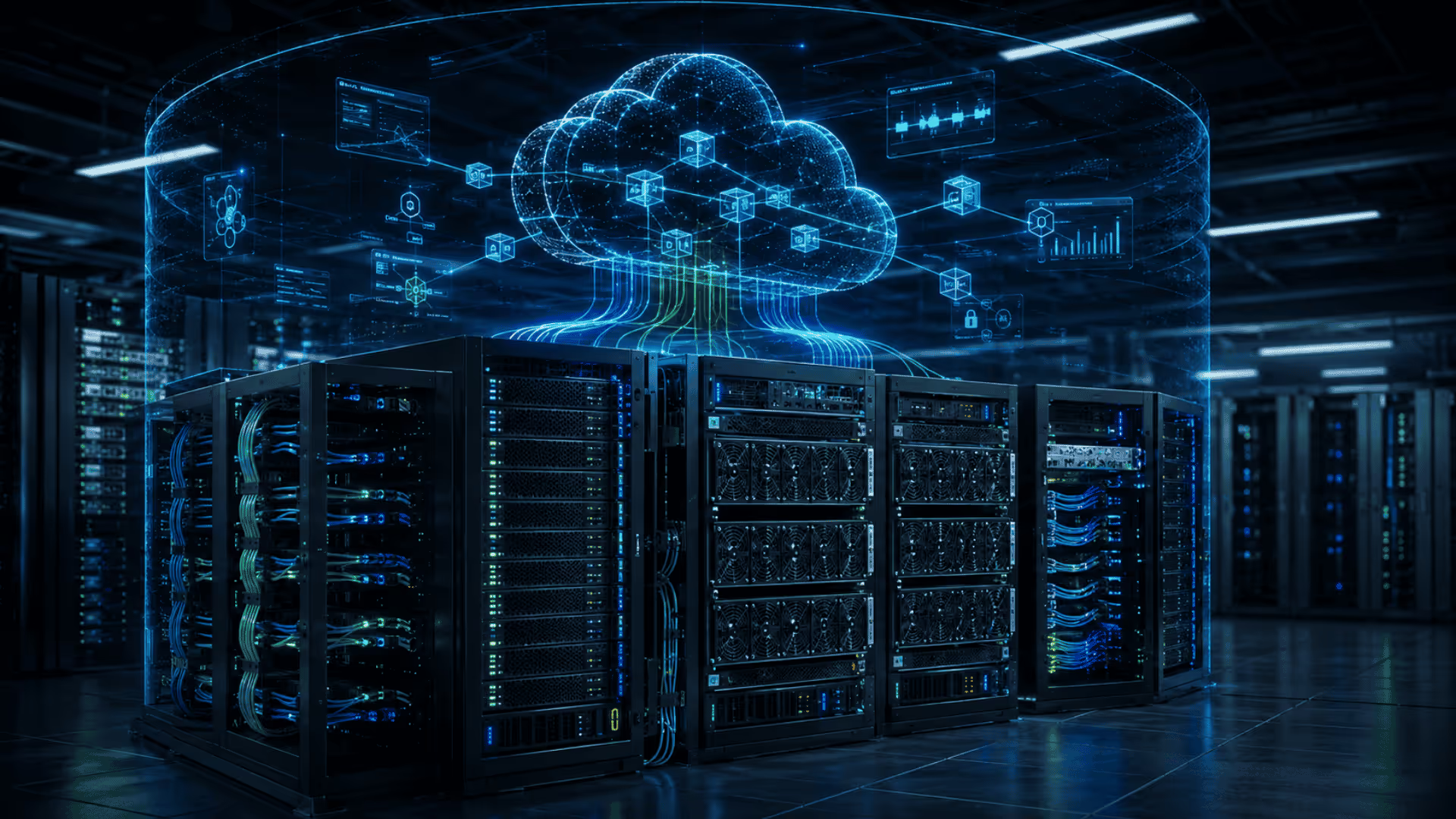
A private AI cloud is dedicated GPU infrastructure designed and deployed for a single organization, with full control over hardware, data, performance, and cost. It delivers a cloud-like operating experience on hardware the organization owns or operates exclusively. Deployment can sit on-premises, in colocation, or hybrid. The defining feature is dedication, not location.
Private AI cloud is not synonymous with on-premises. An on-premises deployment is one form. A colocation deployment with dedicated hardware is another. What makes it private is single-tenant ownership and a control plane the organization governs end-to-end. The older framing of cloud versus on-premises has been replaced by a more useful question: dedicated or shared?
The numbers behind the 2026 repatriation wave
Independent surveys published in the first quarter of 2026 put hard numbers on what operators have been feeling for two years. 79% of enterprises have already moved AI workloads away from public cloud, and 73% plan to shift more on-premises or hybrid over the next two years. Forrester forecasts that at least 15% of enterprises will make private AI deployments their primary AI architecture by year-end.
The shift is being driven by a convergence of three forces:
- Cloud cost unpredictability. Pay-as-you-go pricing penalizes steady-state AI workloads, and data egress fees compound the bill in ways that are difficult to forecast.
- Data sovereignty pressure. Regulated industries, intellectual property protection, and cross-border data flow risk are pushing enterprises to keep AI data and compute inside known jurisdictions.
- Performance predictability. Production AI workloads need consistent throughput. Multi-tenant cloud environments cannot consistently deliver it.
Why public cloud economics break at AI production scale
The gap between cloud pricing for a proof of concept and cloud pricing for a production AI workload is not linear. It is a cliff. The damage compounds across three layers:
- GPU compute. A single 8-GPU H100 instance on Amazon Web Services (AWS) runs $55 to $60 per hour. The same class of instance can cost $80 to $98 per hour on Google Cloud or Azure. Run one continuously for a year and compute alone exceeds a quarter of a million dollars.
- Data egress. AWS egress fees start at $0.09 per GB, with inter-region transfers adding another $0.02 per GB. For workloads pulling training data across regions and writing checkpoints frequently, egress can rival the GPU bill itself.
- Idle capacity. Reserved instances are charged 24/7 whether utilized or not. For steady-state workloads that do not need pay-as-you-go elasticity, this is structural overpayment.
The economics flip at scale. For continuous, predictable AI workloads, dedicated GPU hardware reaches payback in a fraction of the time matched against multi-year cloud spend. Modern private cloud delivers 40 to 50% lower total cost of ownership for steady-state workloads. The more utilized the GPUs, the faster private infrastructure wins. This is the dynamic Arc Compute is built around: designing dedicated AI infrastructure with the AI services to keep it productive, so the economics customers model in the spreadsheet are the economics they actually realize.
How data sovereignty became the other half of the equation
If cost was the only driver, enterprises would just negotiate reserved-instance discounts and stop there. The second force is harder to negotiate away. 91% of enterprise IT decision-makers would choose on-premises, private cloud, or hybrid infrastructure over public cloud when deploying AI that involves sensitive company data. That is not a preference. It is a policy.
Three forces are pushing sovereignty up the priority list:
- Regulatory tightening. Regulated industries face data residency and processing rules that public cloud multi-tenancy struggles to satisfy cleanly.
- Intellectual Property (IP) exposure. Concerns around proprietary model weights and training data have become a board-level concern.
- Geopolitical risk. Cross-border data flow uncertainty is pushing organizations to keep AI data and compute inside known jurisdictions.
The hyperscalers are responding because their customers are already moving. Microsoft launched its Sovereign Private Cloud, built on Azure Local, in February 2026 specifically for AI models running fully disconnected from public cloud. AWS and Google Cloud have built their own sovereign and on-premises variants, including AWS Outposts and Google Distributed Cloud, which now runs Gemini models in air-gapped configurations.
For a deeper look at the sovereignty dimension specifically, see Arc Compute's blog on Data Sovereignty in AI: Why Cloud-Only Strategies Fall Short.
What a 2026 private AI cloud actually looks like
A modern private AI cloud is dedicated AI infrastructure designed around a specific workload profile, deployed in an environment the organization controls, and delivered as a cloud-like experience to internal teams. Well-built deployments share three design dimensions: where the infrastructure lives, who operates it, and what services accompany it.
Where it lives
Three deployment models dominate:
- On-premises. Maximum physical control and the cleanest compliance story. Best fit for organizations with existing data center capacity and the strictest sovereignty requirements.
- Colocation. Dedicated hardware in carrier-grade facilities. The organization retains full ownership while a partner handles facility relationships, power contracts, and physical operations.
- Hybrid. Combines both, often with sensitive workloads on-premises and burst capacity or disaster recovery in colocation.
Who operates it
Three operating models are common in 2026:
- Fully managed. An operations partner runs the entire stack: hardware, networking, monitoring, updates, and optimization. The internal AI team focuses on models and workloads.
- Customer-operated. The internal team operates the environment with full access and control. The partner provides hardware design and escalation support.
- Shared responsibility. Operations are split explicitly, with each layer assigned upfront.
The trend in 2026 is toward fully managed and shared responsibility models, particularly among Chief Executive Officers (CEOs) and Chief Technology Officers (CTOs) who do not want to staff a data center operations team to support an AI strategy.
What gets built underneath
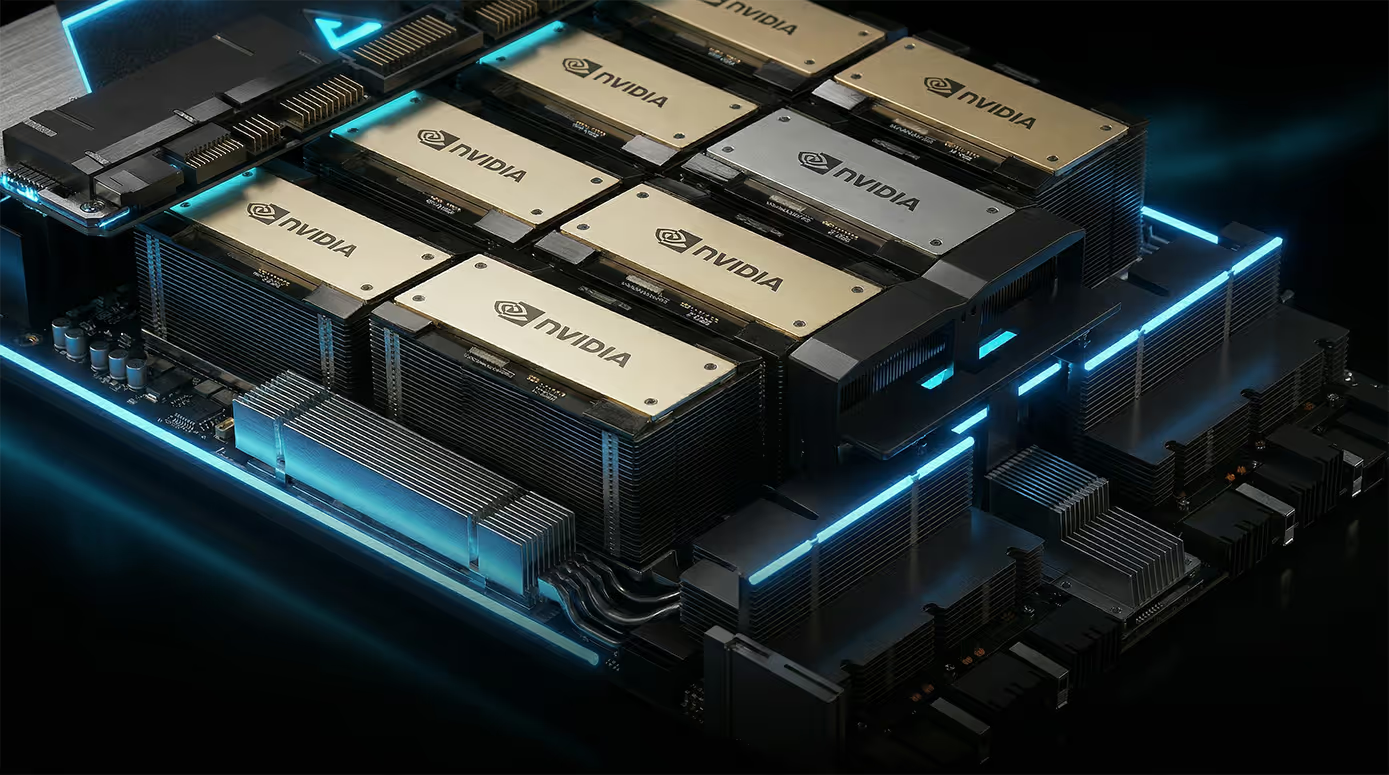
The infrastructure is built on current-generation NVIDIA platforms, with the Rubin architecture entering full production in Q1 2026. Four pillars define the stack:
What runs on top
A private AI cloud is only as useful as the AI workflows running on it. Mature deployments pair the hardware with hands-on AI services that get the infrastructure productive from day one: AI architecture design tailored to the workload, model deployment and optimization within the private environment, pipeline and workflow integration with existing tooling, and ongoing performance tuning as workloads evolve. This is what separates a private AI cloud from a one-time hardware purchase.
Where the private AI cloud trend goes over the next 24 months
Three forward-looking signals matter:
- Budget direction. 86% of enterprises expect AI budgets to grow in 2026, with 40% projecting increases of 25% or more. That funding is flowing disproportionately into on-premises and hybrid infrastructure.
- Hardware cadence. Rubin entered full production in Q1 2026, with volume shipments through the second half of the year and Rubin Ultra scheduled for the second half of 2027. Organizations that cannot align facility readiness with this cadence will pay for it in delayed deployments.
- Hyperscaler repositioning. AWS Outposts, Microsoft Azure Local, Google Distributed Cloud, and the new Microsoft Sovereign Private Cloud are public cloud companies building private cloud products. When the hyperscalers are repositioning to sell on-premises variants of their own services, the market has already decided where AI infrastructure is heading.
Private AI cloud momentum into 2027
The bigger picture
Private AI cloud is sometimes framed as a move against the cloud. It is not. It is a more deliberate, workload-driven placement of AI infrastructure. The organizations repatriating training and production inference are still using public cloud for bursty experimentation, global distribution, and managed services that make sense to rent. What has changed is that sovereignty, cost control, and performance predictability are now non-negotiable for the AI workloads that matter most. The leaders making the calmest moves in 2026 are mapping their AI portfolio against where each workload actually belongs.
For leadership teams working through their own private AI cloud, Arc Compute designs and delivers dedicated AI infrastructure paired with the AI services to make it productive: architecture design, model deployment and optimization, pipeline integration, and ongoing performance tuning. If you are thinking through deployment model, operating model, and how to sequence the move, that is a conversation we are set up to have.
Sources
- Enterprise AI Infrastructure Survey 2026 (commissioned by Cloudian). 93% repatriation stat, 79% already moved, 73% further shift, 91% sovereignty preference, 86% budget growth.
- Cloud Repatriation in 2026 (Forrester prediction, via HyScaler). Forrester 15% private AI prediction; 40% hybrid architecture forecast for 2026.
- CloudZero 2026 GPU cloud pricing analysis. H100 8-GPU instance pricing across AWS, Google Cloud, and Azure.
- DigitalOcean analysis of AWS egress pricing. AWS $0.09/GB outbound, $0.02/GB inter-region transfer cost structure.
- Broadcom 2026 Private Cloud Predictions. Cost and sovereignty as leading CIO concerns for 2026.
- Lenovo Press: On-Premise vs Cloud Generative AI TCO (2026 Edition). Long-term cost dynamics of sustained AI workloads on cloud vs on-premises.
- mrc Productivity: What's Driving Cloud Repatriation in 2026. 40 to 50% lower TCO for steady-state private cloud workloads (cites Broadcom internal analysis); Microsoft Sovereign Cloud February 2026 launch.
- Shopify 2026 Cloud Reset: Cloud Repatriation Strategy. 2026 repatriation landscape analysis and hybrid architecture shift.
- Hivelocity: Cloud Repatriation, Why Workloads Are Moving Off AWS. 53% of organizations experienced faster application performance after repatriation.