Somewhere between the announcement and the purchase order, a rack-scale AI decision stops being about chips.
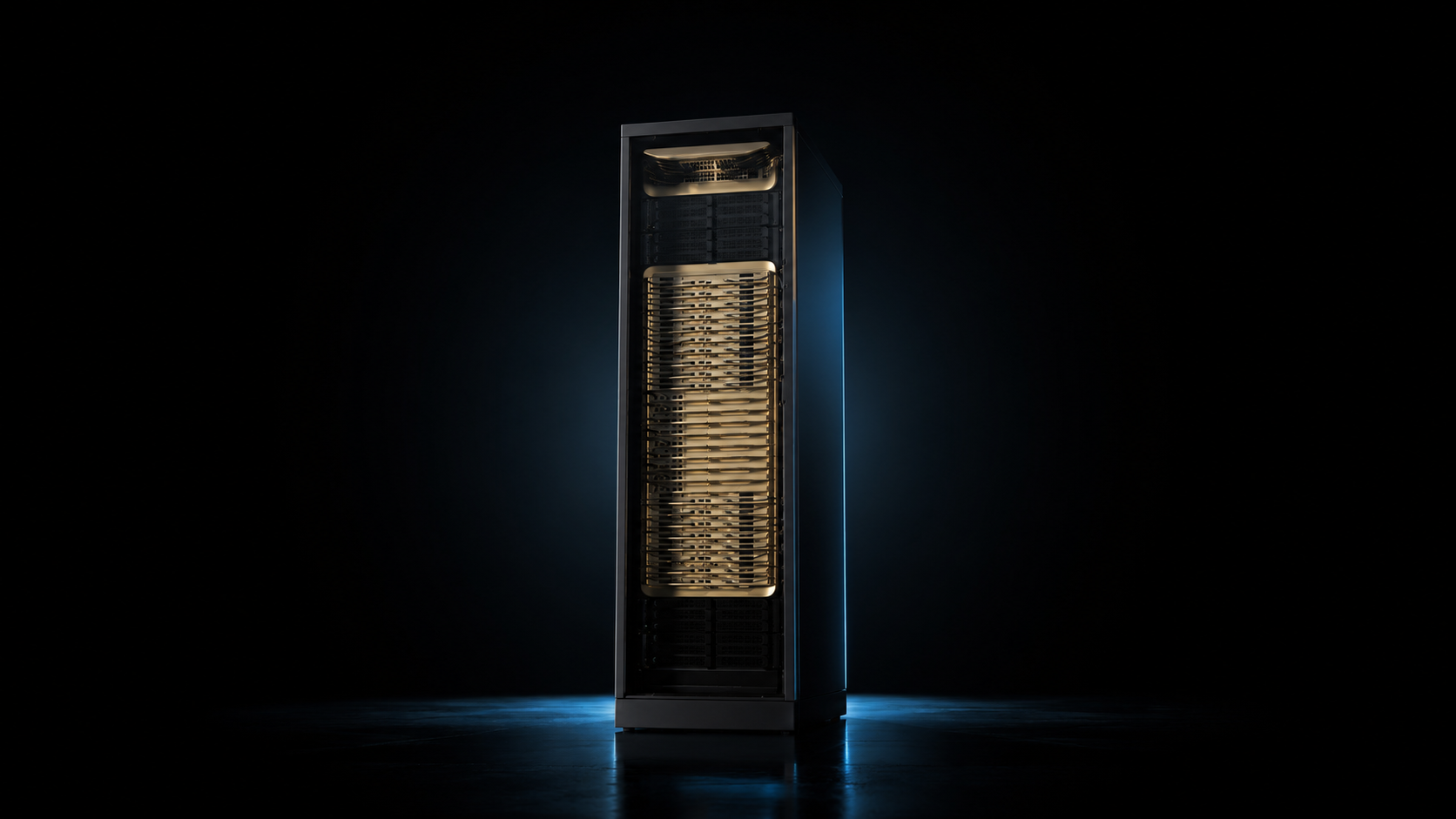
NVIDIA's Vera Rubin NVL72 and AMD's Helios both put 72 GPUs in a single rack, both need liquid cooling, and both reach volume deployment in the second half of 2026. Line up their specifications and you can argue either side. AMD carries 50% more memory per GPU. NVIDIA claims more inference throughput per rack. Neither fact will decide whether the system you buy earns back what it cost.
Three questions decide that, and no specification table answers any of them. Can your building physically take the rack? Does your workload need 72 GPUs on one fabric, or is that a capability you are being sold? And what does it cost, in engineering months, if your software has to move? This guide works through all three, written for the company buying one to four racks rather than the hyperscaler buying a hundred.

Which Vera Rubin NVL72 and Helios specs actually predict cluster performance?
Memory capacity, memory bandwidth and interconnect bandwidth predict how a GPU cluster performs in production. FP4 and FP8 throughput describe node-level efficiency instead. More usable memory per GPU means larger models fit without being split across boxes, and the interconnect decides whether 72 GPUs behave as one pool or as many separate ones.
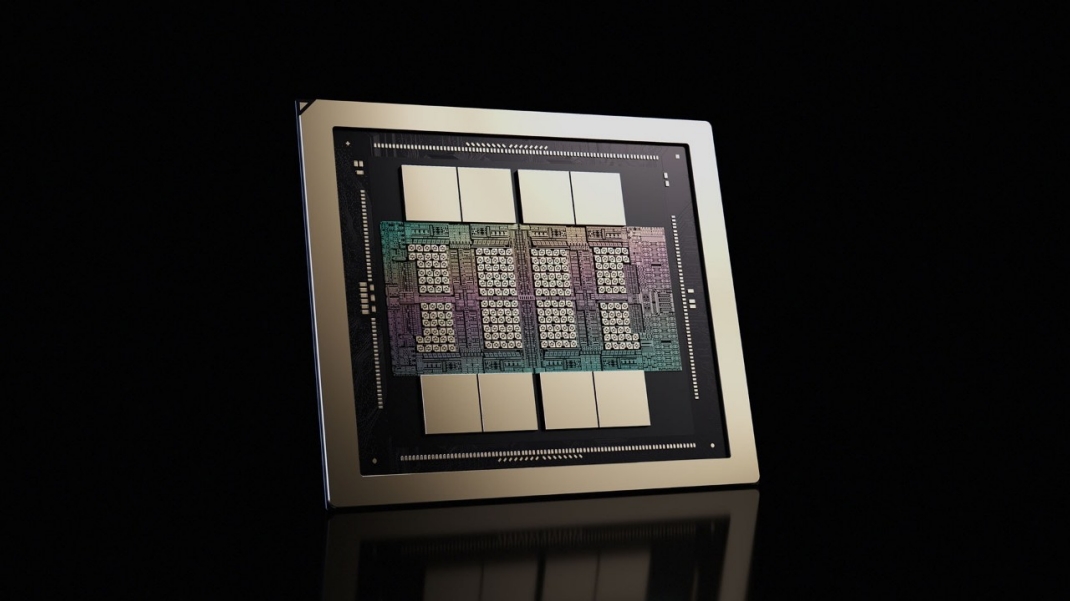
On those three, the two racks sit closer together than the headline compute numbers suggest. NVIDIA confirms 288 GB of HBM4 per Rubin GPU at 22 TB/s, giving 20.7 TB and 1.6 PB/s across the rack. AMD lists 432 GB per MI455X at 23.3 TB/s, giving 31 TB per rack and roughly 1.7 PB/s across the rack. Scale-up bandwidth lands at 260 TB/s on both. The memory gap is real and it favours AMD, but aggregate bandwidth is close to level, so this is a 50% capacity advantage rather than a different class of machine.
One caution before those compute figures reach a board deck. AMD publishes 1.4 EFLOPS of FP8 for the Helios rack. NVIDIA has not published a matching per-GPU FP8 number alongside its NVFP4 figures, so FP8 rows in circulating comparison graphics are not drawn from both vendors' own disclosures. There is also a quality cost no throughput number shows: running a model at FP4 rather than FP8 makes it faster, cheaper and less accurate. A reasonable trade for a narrow task, a poor one for open-ended work.
Rack power is the constraint most buyers discover far too late
Legacy data halls were engineered around 10 to 15 kW per rack. Supermicro sizes the Vera Rubin NVL72 at 227 kW per rack, and Helios has been reported drawing 225 to 245 kW depending on workload over a 50 V liquid-cooled busbar inside the Open Rack Wide cabinet AMD developed with Meta through the Open Compute Project. That is more than an upgrade. It is a different building.
Sequencing follows from that. CBRE reports power availability and delivery timelines are now the most decisive factors in site selection. Ordering hardware before securing somewhere to energise it is the most common way a rack-scale project slips a year.
One widely repeated claim is worth correcting, because it changes the decision. NVIDIA's move to 800 volt direct current distribution does not mean your utility has to deliver direct current. Its reference topology ingests existing 415 or 480 volt alternating current feeds and enters production in the third quarter of 2026. What the site needs is the conversion equipment, room for it, and a liquid loop. The reason for the shift is hard to argue with: at 48 V, an NVL72-class rack draws currents above 2.5 kA and wastes kilowatts in resistive losses. Higher voltage is how that stops being a copper problem.
Plan against the generation after this one as well. Rubin Ultra NVL576 is expected at roughly 600 kW per rack in the second half of 2027. A facility being specified now for a 5 to 7 year life should be designed against that number. Our piece on liquid cooling and the limits of air covers what that density does to thermal design.
Do you actually need rack-scale AI, or will 8 GPU nodes do?
Often the nodes will do. Rack scale links 72 GPUs over a single scale-up fabric and earns its premium when the plan is to grow well past one rack. A single 72 GPU cluster can be assembled from 8 GPU nodes and an 800 gigabit RDMA over Converged Ethernet fabric for less money.
The GB300 NVL72 was the first NVIDIA system where the rack rather than the node was the integrated unit. Before it, a rack was simply a rack of nodes. That integration buys two things: one scale-up domain across all 72 GPUs, and a management model where a rack presents roughly as a single node. At 144 GPUs that is the difference between managing 18 servers and managing 2 racks. We compared the generations in HGX B200 vs B300 vs GB300 NVL72.
What it costs is flexibility. Rack-scale systems arrive as the vendor specifies them. Stepping outside the reference architecture means going back to a node build. The workload argument matters more than the management one. Models above a trillion parameters run on a handful of B300 nodes, and multi-node training coordinates acceptably over an 800 gigabit fabric. Even the east-west traffic created by separating prefill from decode runs over that fabric rather than needing a scale-up domain. Our InfiniBand versus Ethernet comparison and our guide to multi-node orchestration cover where each choice starts to bite.
ROCm vs CUDA: what switching actually costs an engineering team
CUDA is a direct tie between NVIDIA's libraries and the hardware they were built for, and it is the reason most teams never seriously evaluate an alternative. AMD's ROCm stack is capable, and HIPIFY translates CUDA source automatically. The most honest measure of the remaining gap is AMD's own: in internal testing of one application, HIPIFY preserved up to 81% of the CUDA code. That is a strong result, and it still leaves roughly a fifth of the work manual, on a single test case the vendor chose. Hiring follows the same shape: the pool of engineers fluent in the alternative stack is smaller.
Scale is what changes this, and it is already moving. AMD and Meta announced a 6 gigawatt deployment in February 2026, running ROCm on Helios racks the two companies built jointly through the Open Compute Project, with first shipments in the second half of 2026. AMD also committed up to $5 billion to Anthropic alongside a 2 gigawatt supply agreement. Deployments that large fund tooling, and much of that tooling ships openly. Adoption then moves outward: hyperscalers first, the most technical startups next, and enterprises last, once the tooling is something you consume rather than something you build.
What can you actually get delivered in the next 12 months?
GB300 NVL72 racks can be delivered now into any facility that supports liquid cooling. Vera Rubin NVL72 remains largely a hyperscaler conversation through 2026. For a company buying one to four racks, the practical entry point to the Rubin generation is an 8 GPU node rather than a full rack.
Microsoft reported the first hyperscaler power-on of a Vera Rubin NVL72 system in March 2026, with broader cloud availability targeted for the second half of the year. Very few sites can take one today, and that is a facilities constraint rather than a supply one.
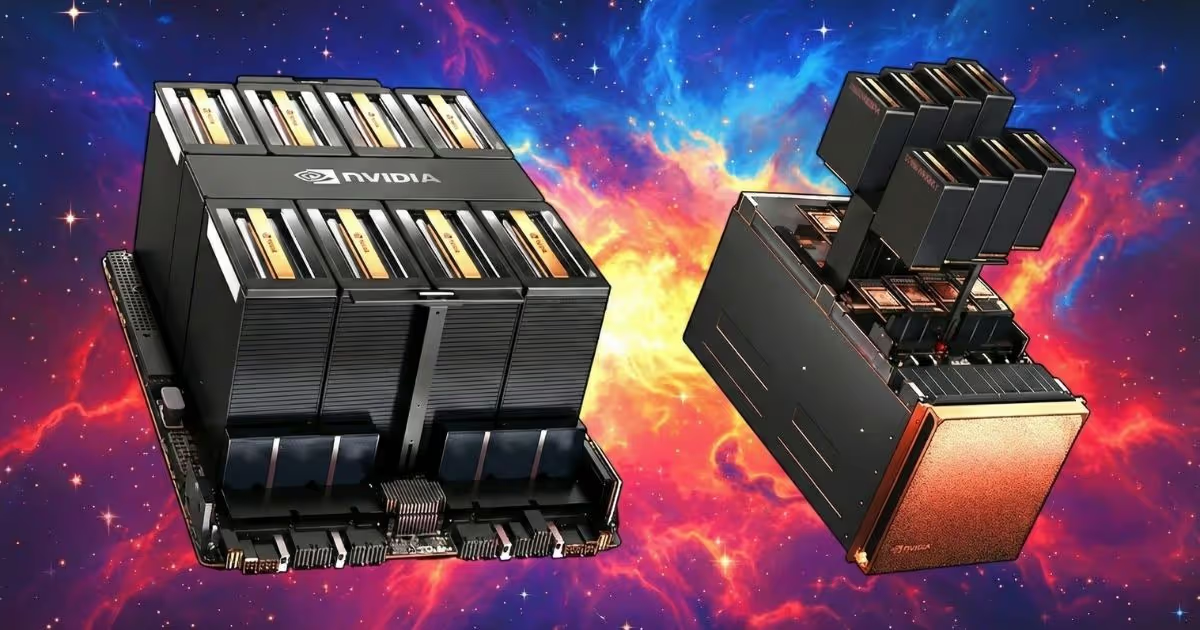
The bridge is the HGX Rubin NVL8, an 8 GPU Rubin system available from Supermicro and Aivres. Arc Compute lists it at roughly 24 kW per system with liquid cooling required, a serious density for one node and still something a conventional data hall can take. It lets a team develop and benchmark on Rubin now, inside an existing facility, then decide on rack scale later with measurements rather than projections.
On price, neither vendor publishes a rack list price, and the percentage gaps circulating in comparison graphics are not vendor figures. AMD has clear reasons to price below NVIDIA while it builds share, but the number belongs in a quote rather than a spec table.
Planning a 2027 purchase when Rubin Ultra is already on the roadmap
Waiting is rarely the right answer, because the cost of delay is a year of not learning. The variable that actually decides sequencing is refactoring. Code written for one architecture runs on the next one, but running and performing are different things.
Teams that built on Hopper and tested on Blackwell generally find the workload runs and delivers nothing close to the gain the hardware should provide until it is refactored. That is a real engineering cost with a calendar attached. Some teams still early in development when Blackwell arrived have stayed on Hopper, planning to skip a generation and move once Rubin is broadly available. Both are defensible. What is not is buying without deciding which one you are doing.
Answer the three questions in order
Building, workload, software. Work through them in that sequence and the vendor question largely answers itself, because most of the shortlist disqualifies itself on the first two. Work backwards from the comparison table and it is entirely possible to commit seven figures to a rack no available facility can energise before 2028.
If you are sitting on any of the three right now, that is worth a conversation before it becomes a quote. Arc Compute's infrastructure engineers will work through them against your actual workload mix, your actual facility and your actual timeline, and tell you plainly when rack scale is not the right purchase. Talk to an Arc Compute engineer about your 2027 build.
Sources
- NVIDIA, Rubin platform announcement
- ServeTheHome, NVIDIA Rubin platform at CES 2026
- AMD, Helios rackscale solution
- AMD, Helios built on Meta's OCP Open Rack for AI design
- StorageReview, AMD MI455X and Helios detailed
- Supermicro, NVIDIA Vera Rubin NVL72 rack sizing
- StorageReview, NVIDIA 800 VDC power architecture moves to production
- The Register, data centre power architecture and NVL72-class density
- NVIDIA, gigawatt AI factories and OCP contributions
- CBRE, North America Data Center Trends H1 2026
- Data Center Dynamics, Rubin Ultra NVL576 expected at 600 kW
- Data Center Dynamics, Microsoft first to power on Vera Rubin NVL72
- AMD, from CUDA to ROCm without starting over
- AMD and Meta, 6 gigawatt partnership, 24 February 2026
- Tom's Hardware, AMD and Anthropic 2 gigawatt agreement
- Supermicro, support for Vera Rubin NVL72 and HGX Rubin NVL8
- Arc Compute, NVIDIA HGX Rubin NVL8 servers