The published price of a token has fallen sharply. Almost nobody's inference bill has followed it down.
That gap is now large enough that analysts have named it. According to Gartner, 2026 is the first year inference spending, at $23.3 billion, exceeds training spending at $19 billion. Gartner also predicts inference cost per agentic workflow will rise more than fivefold through 2028, a pattern it calls the Inference Paradox: better unit economics producing higher total cost.
For teams running production inference this shows up as a cluster that works but underdelivers, or an invoice that grew while the per-token rate shrank. The causes are architectural, and visible before hardware is ordered.

Why are AI inference bills rising when token prices keep falling?
Driving the unit cost of a resource down decreases the barrier to entry and increases utilization. This is known as the Jevons Paradox. It is the same phenomenon we saw with server infrastructure virtualization, and AI inference is now following the same curve.
Microsoft chief executive Satya Nadella applied the idea directly to AI in January 2025: as AI becomes more efficient and accessible, its use expands. Inside a company, the effect is straightforward. If only four teams can justify an AI workload at today's price, cutting the cost by 30% or 40% makes it viable for more teams. The cost per token falls, but the number of workloads grows.
That does not mean existing users suddenly consume far more just because tokens are cheaper. A study of more than 100 trillion tokens found that a 10% price reduction increased usage among existing users by only about 0.5%. Much of the growth instead comes from new users and new workloads becoming economical.
Virtualization followed a similar pattern. It reduced the amount of physical hardware needed for individual workloads while making computing resources easier and faster to provision. By 2016, Gartner described the x86 server virtualization market as approaching saturation, with many organizations reporting virtualization rates above 75%. Instead of requiring a dedicated physical server for every workload, organizations could run multiple virtual machines on shared infrastructure and provision new environments much more quickly.
The lesson is that efficiency can reduce the cost of each unit without reducing total demand. AI inference appears to be following that pattern: cheaper tokens make more applications economically viable, which creates more workloads and pushes overall consumption higher.
Efficiency also fails in a way that token pricing alone cannot capture. A cheaper model is not cheaper if it struggles to complete the task. An agent can loop, consume more tokens and engineering time, and still produce an unusable result. If the workload eventually has to be rerun on a frontier model, the apparent savings disappear.
For AI teams, then, cost per token is only part of the equation. The more useful metric is cost per completed task.
The prompt caching discount is real, and it is conditional
Prompt caching is widely treated as a solved cost problem, and the headline numbers support that reading. OpenAI bills cached input on GPT-5.6 and later at 10% of the uncached rate, Anthropic and Google Gemini use the same 0.1x multiplier, and DeepSeek prices cache hits at roughly 2% to 3% of a miss. The conditions attached to those numbers are where budgets break.
Most providers now charge a premium to write a cache entry. Anthropic bills 1.25x base input for a 5 minute entry and 2x for a 1 hour entry, and OpenAI applies the same 1.25x write rate on GPT-5.6 and later, a change from charging nothing. That creates a break-even point: a prefix has to be reused at least once inside its lifetime before caching beats not caching. Written once and never reused, it costs 25% more than no cache at all.
Cache lifetimes are short enough to matter. Anthropic's default entry lasts 5 minutes and OpenAI's window on current models is 30. Google bills explicit cache storage by the hour, so a low-traffic cache on Gemini Pro can cost more than no caching.
Agent systems then break their own caches, often silently. Anthropic's cache diagnostics name four failure states, each of them something agent frameworks do routinely: tool definitions added, removed or reordered; a timestamp written into the system prompt; history re-serialized differently between turns; a fallback selecting a different model mid-session. OpenAI lists the same triggers, down to adding a single space.
A miss does not simply forfeit the discount. The prefix is re-billed in full, and if written again at the write rate, a 12.5x swing against a hit. Cache reads are also charged on the whole accumulated prefix, so cumulative input cost grows roughly with the square of a conversation's length.
Caching carries a second consideration worth knowing about. Because a cached prefix returns faster than an uncached one, a shared cache is also a timing signal, and an audit of 17 providers found several sharing caches across customers. The major providers now scope them per organization.
What changed underneath inference infrastructure?
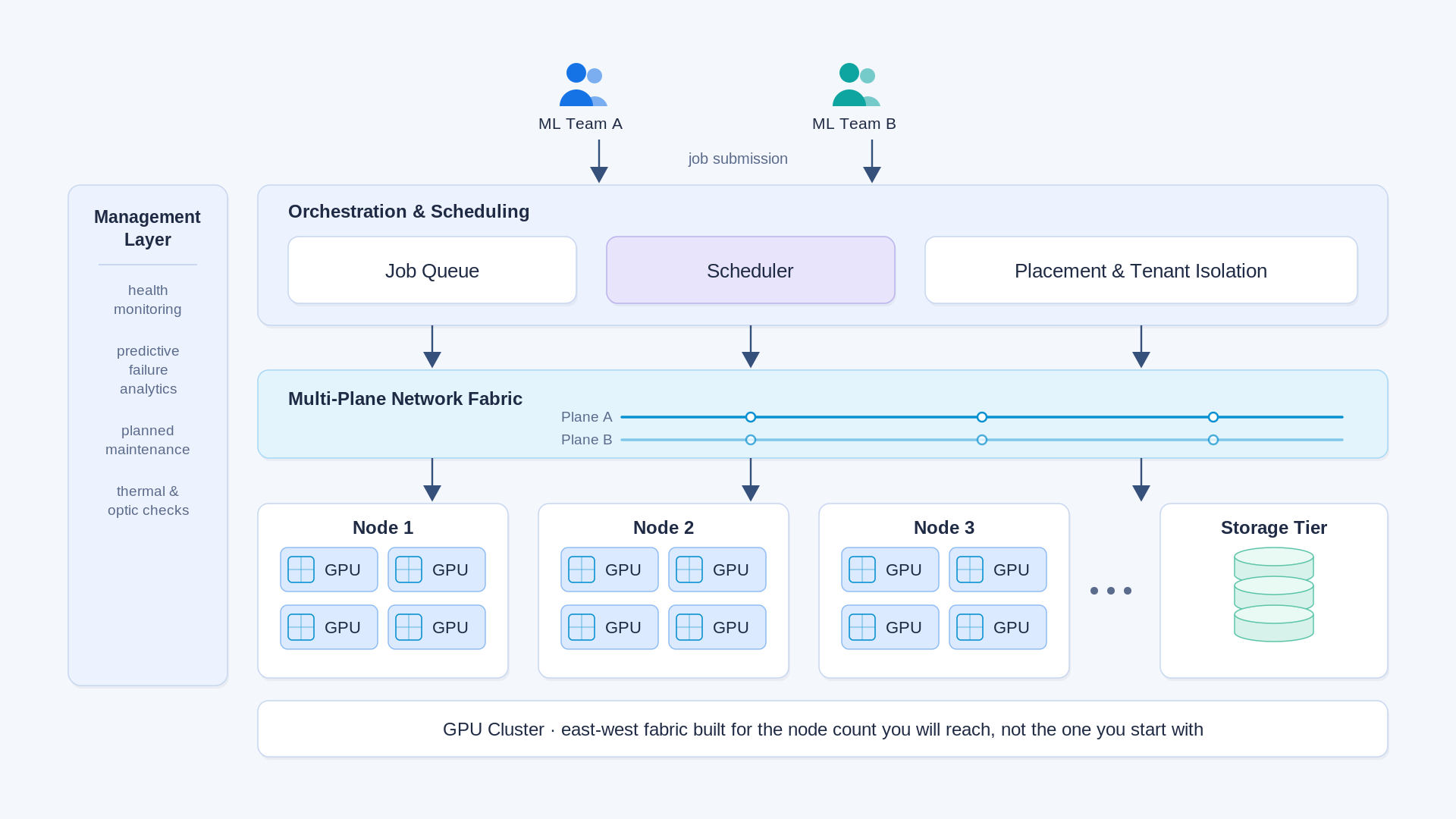
Inference was simpler when workloads ran on a single node and network traffic mostly flowed in and out of that server. With models now reaching into the trillions of parameters, production inference often runs parallel instances across multiple nodes to support low latency, redundancy and many simultaneous users. Cached prefill and the separation of prefill from decode add another layer of traffic by moving key-value (KV) cache data between servers. Together, these changes generate more east-west traffic, so inference clusters increasingly need the back-end fabric that training clusters have long relied on.
The mechanism is straightforward. Prefill, which processes the prompt, is compute-bound, while decode is memory-bound. Separating them lets each run more efficiently, but it also means the KV cache produced during prefill must reach the decode engine before the first token appears.
Model growth compounds this. Two copies of a large model no longer always fit on one server, so the replica and its prefill cache sit on a different box. Routing that east-west is deliberate: it keeps replication off the path serving inbound requests, where users feel latency.
NVIDIA is unambiguous about what this requires. Its Dynamo deployment documentation states that Remote Direct Memory Access (RDMA), over InfiniBand, RDMA over Converged Ethernet (RoCE), or equivalent, is required for production disaggregated deployments, and that without it teams should expect 200x to 500x degradation in time to first token. AMD's ROCm tutorials also list an RDMA network card as a requirement for this architecture.
On identical hardware, the fabric alone decided whether the system answered in under a second or took almost seven. One published benchmark on 8 A100 GPUs running Qwen3-32B recorded an average time to first token of 6,785 milliseconds over TCP against 796 milliseconds over RDMA. Inter-token latency was identical, so the fabric bought responsiveness rather than generation speed.
How this interacts with scheduling across nodes is covered in our guide to GPU cluster orchestration and scheduling.
How far a model pushes a team over this line varies more than most planning assumes. DeepSeek's V4-Pro carries 1.6 trillion total parameters with 49 billion active per token and ships at roughly 960 GB, which fits one 8 GPU H200 node. Alibaba's open-weight Qwen3.6-27B is roughly 54 GB at BF16 and fits on one GPU. The corollary is worth saying plainly, even from a hardware vendor: most teams do not need the largest model, or the newest accelerator. Matching the model to the workload is often a bigger lever on cost than anything decided at procurement.
Does every inference cluster need a back-end network?
Not every cluster does. Below roughly a rack, chunked prefill on a single node remains the right default and adds no network requirement. The dependency appears at a threshold, either when a model exceeds one node's memory or when prefill and decode are separated across nodes.
That threshold is also moving. Newer sparse and hybrid attention designs are cutting the volume of KV cache that has to cross the network, which raises the point at which a back-end fabric becomes necessary rather than lowering it.
The opposite error is also expensive. Published analysis puts clean prefill and decode separation at roughly a thousand GPUs and above, because smaller deployments cannot split the two pools usefully, and colocated serving has been measured winning on time to first token until the KV cache outgrew GPU memory.
Where the market has landed is not in doubt. Dell'Oro Group reported that in the second quarter of 2026, AI back-end switch sales surpassed front-end sales for the first time, with 800 gigabit ports accounting for the vast majority of Ethernet switch revenue.
Sizing for the workload mix you actually have
There is no general rule of thumb for headroom, and treating one as if it exists is how clusters end up wrong. Buyers rarely arrive with a single workload either. A typical requirement covers agents, an internal chat product, an AI feature in a commercial product, batch inference for research, and a fine-tuning run, all on one cluster.
Where the waste shows up afterwards is a separate question, one we covered in where inference budgets actually leak. That makes sizing a sequencing decision. Buying for 6 months of growth lowers the outlay and accepts a second procurement cycle at whatever lead times apply then. Buying for 12 months costs more upfront and removes that exposure.
When owning inference capacity stops making sense
Ownership is a return on investment question. Put the full cost of ownership on one side: hardware, networking, storage, colocation, power, connectivity, and the people to run it. On the other, the cost of the same token volume from a model provider. When the second number is lower for the workloads a team runs, renting wins, and that is a legitimate answer.
That comparison only applies if the workload can sit on shared public infrastructure at all. Where data residency, a regulator or a customer contract requires infrastructure you control, the cloud versus on-premises question is already answered, and two decisions remain: whether you own the hardware or consume it as a service, and who operates it.
It is worth being clear about why so many teams sit on a general-purpose cloud to begin with. A large share went there to keep capital expenditure off the balance sheet, not because the cloud suited the workload. Where the objection is accounting rather than architecture, dedicated infrastructure consumed as a service answers it without the general-purpose pricing.
That points at a decision most procurement processes never make explicit. Consumption and management are separate choices.
Projects fail when these collapse into one. A buyer who wanted flexibility and better economics is handed a quote for servers and told to run them, which was never the requirement. Arc Compute works through both axes before anything is specified, because the answer changes the hardware, the network, and the operating model.
Designing for the bill you will actually get
If inference costs are climbing faster than usage, the answer is usually in the architecture rather than the invoice. Arc Compute models these decisions against real workloads with infrastructure and machine learning leaders, across turnkey GPU clusters, private AI cloud deployments, and managed operations. If you are sizing for agents and want to know what the fabric costs before committing, that is worth discussing early.
Sources
- Gartner, AI-optimized IaaS forecast, 10 August 2026
- Gartner, inference cost per agentic workflow, 17 August 2026
- OpenAI, prompt caching guide
- OpenAI, API pricing
- Anthropic, prompt caching documentation
- Anthropic, pricing
- Anthropic, cache diagnostics
- Google, Gemini API pricing
- Google, Gemini context caching
- DeepSeek, models and pricing
- DeepSeek, V4 model card
- vLLM, DeepSeek V4-Pro serving recipe and verified hardware
- Auditing Prompt Caching in Language Model APIs, ICML 2025
- NVIDIA, Dynamo disaggregated inference communication guide
- NVIDIA, Dynamo disaggregated serving design
- NVIDIA, H200 specifications
- AMD, ROCm SGLang prefill and decode disaggregation tutorial
- Microsoft, AKS engineering blog on RDMA for AI, 1 April 2026
- Qwen3.6-27B model card
- Practitioner benchmark, RDMA versus TCP KV cache transfer, April 2026
- llm-d, networking for distributed inference, 23 June 2026
- Dell'Oro Group, AI back-end switch sales surpass front-end, 3 September 2026
- Data Center Knowledge, AI data center networking, 20 August 2026
- Disaggregation is a thousand GPU problem, 4 September 2026
- Comparative study of colocated and disaggregated serving, arXiv:2601.08833
- William Stanley Jevons, The Coal Question (1865), and the Jevons paradox
- Satya Nadella on AI efficiency and Jevons paradox, 27 January 2025
- OpenRouter, State of AI: an empirical 100 trillion token study
- Gartner, x86 server virtualization reaches saturation, 2016
- IDC, virtual machine shipments pass physical servers in Western Europe, 2008
- Gartner, worldwide server shipments 2006
- Gartner, worldwide server market full year 2013