The AI cost conversation has changed. Per-token prices keep falling, yet total bills keep climbing, because agentic workloads consume tokens at a pace few teams budgeted for. In the FinOps Foundation's State of FinOps 2026 survey of 1,192 practitioners, 98% of organizations said they now manage AI spend, up from 31% 2 years earlier, and AI cost management ranked as the top skillset teams need to add. Gartner projects that 55% of AI-optimized infrastructure as a service (IaaS) spending will support inference workloads in 2026, climbing past 65% by 2029.
The instinctive response is to downgrade to a cheaper model and accept the quality hit. That trade is usually unnecessary. In our work designing and operating GPU infrastructure, we see most inference waste sitting below the model: in the physical build, the daily operations, the serving experience, and the missing guardrails. This article breaks down all 4, with the numbers to size each one.

What Is GPU FinOps?
GPU FinOps is the practice of applying financial operations discipline to GPU infrastructure. It spans cost visibility, governance, and utilization management across 4 layers: physical infrastructure design, ongoing hardware operations, the serving layer teams consume, and guardrails around consumption. The goal is predictable inference economics without sacrificing model quality.
Most organizations are still building this muscle. The single most requested tool capability in that same survey was granular monitoring of AI spend, covering tokens, large language model (LLM) requests, and GPU utilization, which tells you how few teams can currently see their costs at that resolution. Visibility comes first; the savings follow.
Where Do Inference Budgets Actually Leak?
Inference budgets rarely leak where teams first look. The biggest losses sit below the token line: networks overbuilt for training rather than inference, integration planned after the hardware order, component failures nobody catches early, and capacity nobody uses.
Networks built for the wrong workload
Training clusters need heavy east-west bandwidth between nodes. Inference clusters usually do not. Many buyers still copy a full training reference architecture and spend heavily on an InfiniBand or RDMA over Converged Ethernet (RoCE) fabric their workload will never saturate. It is one of the fastest ways we see teams burn capital that could have bought more compute.
Integration treated as an afterthought
A company built around cloud-native workflows cannot drop hardware into a colocation facility and expect it to slot in. Identity, deployment pipelines, monitoring, and data paths all need a plan for the moment on-prem infrastructure joins the stack. In our experience, integration handled late is the biggest reason GPU projects fail, so that plan should be finished before anything is ordered.
Hardware left unmanaged
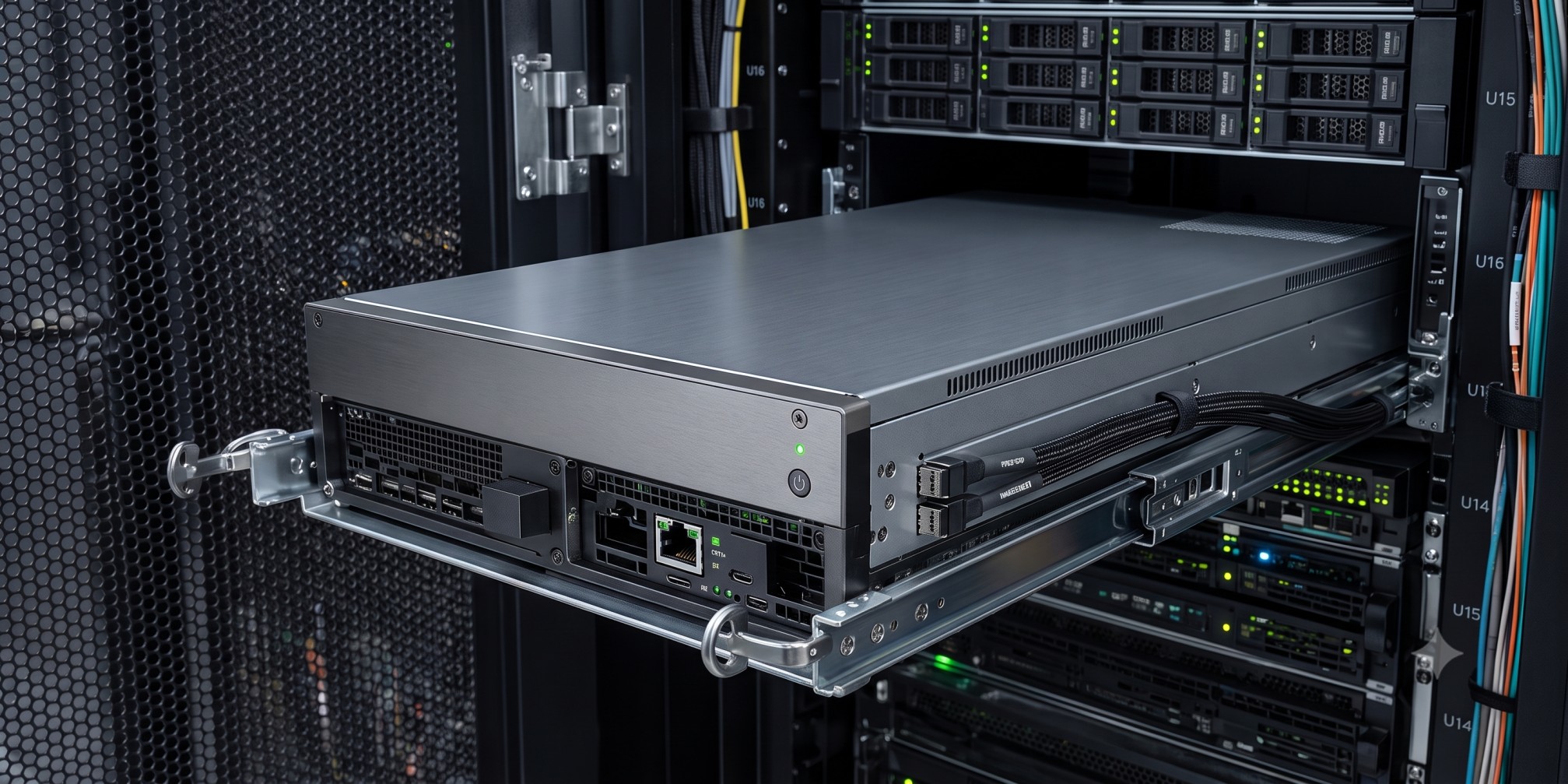
GPUs fall off the bus. Optics turn intermittent. Network cards die. We recently took over a cluster where the network was miscabled and the switch layout meant a single switch failure could take roughly 20% of the cluster offline. The owner ran below full capacity for months, then paid again to have the network rebuilt properly. When teams tell us they are not getting the output or the ROI they were promised, the root cause is usually infrastructure, not the model.
Capacity nobody is using
Cast AI's 2026 State of Kubernetes Optimization Report, based on telemetry from tens of thousands of non-optimized clusters, found GPU utilization averaging just 5%. At that level, 95% of accelerator spend is buying idle silicon.
What Is the Single Biggest Lever to Cut an Inference Bill?
The single biggest lever is model routing: reserve large frontier models for reasoning, planning, and structure, then hand execution to smaller, cheaper models suited to each task. Matching every request to the least expensive model that clears the quality bar cuts token spend sharply while output quality holds steady.
We call this the harness model. The expensive frontier model does the thinking: it structures the approach, plans the work, wireframes the output. Smaller open-weight models then execute against that plan, because delivering on a finished spec does not demand frontier reasoning. In most workloads we audit, the bulk of requests never needed the flagship model in the first place.
The market is converging on the same playbook. TechCrunch reported in June 2026 that model routers which automatically pick a model for each task are emerging across the industry, and that engineering intelligence platform Jellyfish found the heaviest token users were roughly 2x as productive as lighter users while consuming 10x the tokens. Spend scales faster than output unless something decides which model each request deserves.
Routing also needs guardrails. During platform testing in our own lab, we watched an agent get stuck in a tool-call loop and burn $70 in tokens without producing anything. As a lead of infrastructure, troubleshooting a runaway agent is part of my job. For a marketing manager trying to meet a deadline, it is not. That failure is cheap at test scale and existential at fleet scale: J.R. Storment, executive director of the FinOps Foundation, told TechCrunch that companies were discovering in April that they were 3x over their entire 2026 token budget. With Goldman Sachs projecting global token usage to grow roughly 24x by 2030, unattended consumption only gets more expensive. Quotas, capacity metrics, per-team budgets, and loop detection should exist before agents ship, whether you build the serving platform or license one with those controls built in.
The Adoption Trap: Hard-to-Use Infrastructure Is Pure Cost
The subtler loss is adoption. If the goal of internal AI infrastructure is to move teams off public tools, ease of use decides whether they actually move. If it is harder than ChatGPT, people will keep using ChatGPT. Shadow IT has returned as shadow AI, and it is measurable: UpGuard's 2025 State of Shadow AI report, surveying 1,000 employees and 500 security leaders, found 81% of employees using unapproved AI tools and 45% finding workarounds when tools are blocked. Blocking does not fix adoption. A better internal product does.
Adoption rate belongs on the same dashboard as utilization and spend, and a simple monthly review of active users, requests served, and cost per request will surface a problem long before the renewal conversation does. A cluster your teams route around is not a cost optimization problem. It is 100% waste wearing a capacity report.
Quantization, Caching, and Memory Placement in Plain Terms
Three technical levers dominate optimization conversations, and each pays off only when matched to the right constraint.
Quantization reduces a model's numerical precision so it fits on smaller or fewer GPUs. That lets you run more instances of the same model on existing infrastructure, or the same workload on less hardware. The price is precision, which makes it best suited to capacity-constrained teams and tasks that tolerate it.
Key-value (KV) cache optimization keeps context as close to the GPU as possible, holding attention states in high-speed memory instead of recomputing them. Hardware with a fast memory tier between GPU memory and system memory extends this further, letting larger models run in staged chunks on smaller systems.
Prompt caching stores prompt and output pairs so identical requests skip the model entirely. Every major platform does it. The risk: a cached answer that was wrong, or has gone stale, gets served repeatedly until someone invalidates it. Caching needs management, not just activation.
None of these should degrade output quality when applied deliberately. The failure mode is applying them blindly: quantizing a model whose task demands precision, or caching outputs that should expire.
When Does Owning Inference Infrastructure Beat Renting?
Ownership wins when sustained token volume makes the financed cost of a cluster lower than the equivalent API or cloud GPU spend. The math is knowable: estimate token throughput for a reference cluster, compare 3-year financing against current per-token costs, and keep utilization honest. Steady production inference crosses that line first.
Published throughput data for current-generation GPU nodes makes that calculation practical rather than theoretical, and the same spreadsheet should carry the hidden line items too: colocation power, spare parts, and the engineering hours to run the stack. Rental pricing is not helping the other side of the ledger either. Cast AI's report notes that cloud vendors raised H200 prices 15% in 2026, breaking a 20-year trend of falling compute costs.
The discipline is to buy for today while designing for growth. Our rule of thumb: plan on-prem capacity around 80% of typical load. When demand spikes past what you own, burst to rented compute through a serving platform that spans both environments. When steady-state utilization keeps hitting 90%, buy the next node and bring usage back under 80%. You expand in small steps as demand materializes, instead of financing 2 years of projected demand on day 1.
That hybrid pattern preserves the economics of ownership without giving up elasticity. Making it work comes down to picking the right platform, or the right team, so that tiering out to a hyperscaler during spikes is seamless: the same serving layer runs on the hardware you own and on the capacity you rent, and scaling out is simply adding a node to the environment you already operate. For a deeper decision framework, see our practical guide on when an AI startup should move off the cloud and our look at why enterprises are shifting toward private AI cloud.
Inference Economics Is an Operating Discipline
Protecting model quality while cutting inference spend is not one decision. It is the accumulation of smaller ones made at every layer, and each either compounds savings or compounds waste, daily.
A useful starting question for any leadership team: which of the 4 layers is leaking the most right now? If nobody can answer with data, that gap is the first fix.
For teams working through that question on real infrastructure, Arc Compute designs, deploys, and manages GPU clusters and private AI cloud environments with these economics in view, from initial design through day-2 operations and hybrid scale-out planning. If your inference bill is growing faster than the value it produces, a conversation about the layers underneath it is usually worth more than another round of model downgrades.
Sources
- FinOps Foundation, State of FinOps 2026 Report
- Gartner, AI-Optimized IaaS Is Poised to Become the Next Growth Engine for AI Infrastructure (October 2025)
- Cast AI, 2026 State of Kubernetes Optimization Report (April 2026)
- TechCrunch, The token bill comes due: Inside the industry scramble to manage AI's runaway costs (June 2026)
- UpGuard, The State of Shadow AI (2025)