The failure that costs regulated buyers the most is not a breach. It is getting three quarters of the way through a proposal and discovering the architecture underneath it was never going to meet their requirements.
The cost of that discovery is not just the wasted procurement cycle. Restarting the search pushes the programme out by a quarter or two, which delays the product the infrastructure was meant to support and the revenue attached to it. For teams under pressure to move quickly, that opportunity cost is usually larger than anything negotiated on price.
Organisations handling regulated data are usually careful, and outright leaks are rare. What is common is the late discovery: a storage platform that is excellent on performance but awkward to run multi-tenancy, or a provider whose entire fabric sits in one undivided subnet. Neither shows up on a certification badge, and both are findable with the right questions asked early.
This is a security conversation rather than a procurement one, which means it belongs to the chief information security officer, supported by a network engineer and someone who understands how the platform is actually architected.
What does single tenant actually mean?
Single tenant, dedicated and isolated all mean roughly the same thing: this is yours. The question that matters is what "this" refers to. Applied to a cluster, it covers the internet connection, firewalls, switches, servers and storage. Applied to a server, the connection, firewalls and switches are shared. Applied to a GPU, almost everything else is shared.
Two other words get grouped with these and should not be. Air-gapped means offline, which is a different property altogether. Bare metal describes who installs the operating system, not who else is on the hardware, and it belongs nowhere on an isolation checklist.
Three levels of isolation, and what each one costs
Isolation is a spectrum with a price attached at every point, and the right answer depends on what the data actually requires.
Hard isolation means fully disaggregated infrastructure. Four customers wanting 8 node clusters get four distinct 8 node clusters, each with its own switches, firewalls and internet connections. It is the cleanest separation and the most expensive, because at 8 nodes a switch sits mostly empty and every customer needs another. Defence contractors and governments generally require it.
Network isolation is the middle option. A virtual network is extended down to each node, so a shared physical cluster can be divided along logical lines: 32 nodes and four customers becomes four clusters of eight, with far fewer switches, firewalls and connections to buy. Healthcare organisations are often comfortable here, provided the segmentation is real. The mechanism is usually VXLAN, defined in RFC 7348, which is worth knowing carries no encryption or authentication of its own. It separates traffic; it does not protect it.
Virtual machine and container isolation sits below that. Tenants share a node, each workload runs in its own virtual machine, and GPUs are passed through individually. It is the most economical and the most dependent on everything above it being configured correctly.
Isolating the network is not the same as isolating the cluster
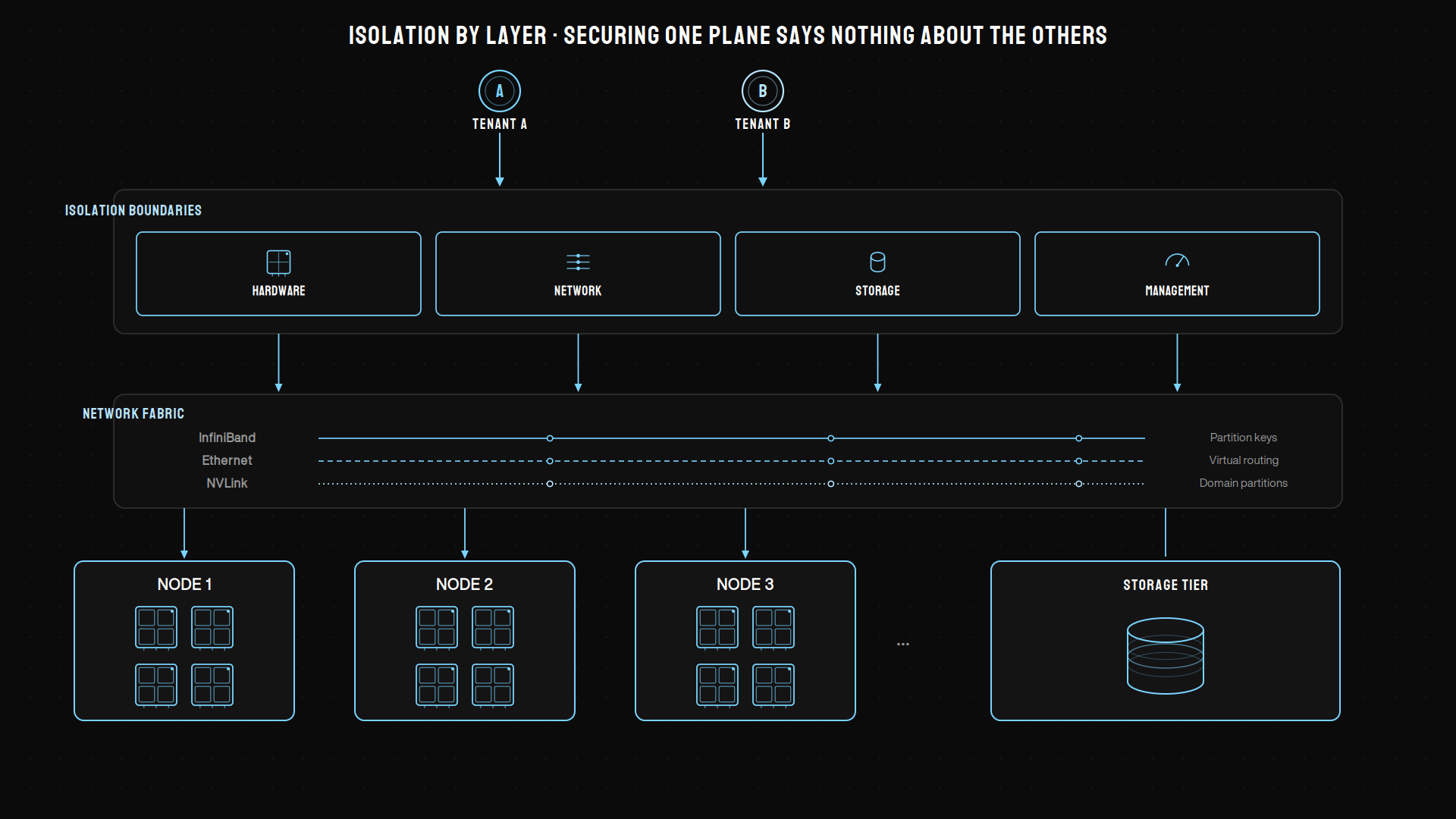
A GPU cluster has more than one network, and each needs isolating separately. NVIDIA's own multi-tenant documentation uses a different mechanism for each plane: virtual routing on the Ethernet side, partition keys on the InfiniBand fabric, and partitions inside an NVLink domain. Securing one says nothing about the others.
The east-west fabric is where this is most often missed. On InfiniBand, tenants are separated by partition keys assigned centrally by the subnet manager, and NVIDIA is explicit that nodes cannot determine their own partitions. The common failure is leaving the default partition live, so nodes belong both to their tenant partition and to one that holds every host on the fabric.
That is not theoretical. In an audit of 25 providers across 32 clusters published in August 2026, SemiAnalysis found one provider where a single query returned 532 hostnames and endpoints, exposing other customers and internal partitions. At another, a shared monitoring dashboard showed logs and metrics for every tenant on the platform, including banks, telecoms and a national intelligence agency.
Can two tenants safely share one GPU?
Not if they are competitors. Splitting a GPU by time-slicing gives no separation worth relying on: NVIDIA states plainly that there is no memory or fault isolation between replicas. Hardware partitioning is stronger, but it is not a security boundary either.
Multi-Instance GPU is the better mechanism, and NVIDIA documents real hardware separation: each instance gets isolated paths through the memory system, including its own cache banks, memory controllers and address buses. It is supported across Hopper and Blackwell, including the RTX PRO 6000 Blackwell.
What partitioning does not cover is the microarchitecture around it. Research presented at USENIX Security in August 2026 showed that memory barriers issued in one instance affect timing in another, leaking kernel launch patterns across the boundary, and the authors note this compromises the confidentiality of workloads including large language model inference. Separately, the virtual GPU manager has a running history of vulnerabilities whose documented threat actor is a malicious guest.
GPU sharing still has a place, provided the right workloads are the ones sharing. Virtual desktops are the obvious case, since nobody running a desktop session needs 96 GB of video memory, and partitioning a card across many users is exactly the right call. What matters is who the neighbours are. Two teams inside the same organisation sharing a card is a risk decision that organisation can make for itself, because both workloads answer to the same security policy. Two competing customers sharing a card is a different proposition, and it is one that partitioning alone does not resolve.
Cache sharing deserves the same scrutiny. Prefix caching reuses computed context between requests, and a cached prefix returns faster than an uncached one, which makes it a timing signal. An audit of 17 API providers found 7 of the 8 that cached were sharing globally across customers; most have since isolated them. The serious version is closer to home. Work presented at NDSS 2025 reconstructed 81% of victim prompts on a multi-tenant deployment whose cache was shared across tenants. If you serve several tenants from one cache, scope it per tenant.
Storage is where tenancy quietly breaks
High-performance parallel filesystems were built for one organisation with cooperating users. Multi-tenancy was added afterwards, and it usually rests on identifying tenants by network position rather than by cryptographic identity. Lustre, for example, identifies clients by network identifier, so the model only works if those identifiers cannot be spoofed. The maintainers list three ways to earn that trust: restrict root on the client, authenticate properly with Kerberos or shared keys, or separate tenants at the network layer.
A bare-metal tenant with root on the node removes the first option by definition. Storage isolation then inherits whatever the network isolation is worth, which is why the two questions cannot be asked separately.
The questions to ask before you sign
Most of this can be settled early with a short list, asked of the architecture rather than the certifications.
On logs, a certification is not the same as a capability. A report attests that chosen controls worked over a past period; it does not oblige a provider to hand you your own tenant records. Retention benchmarks vary widely, with FedRAMP requiring 90 days online and payment card rules asking for 12 months, so the number to agree is the one written into the contract rather than the one on a badge.
This matters more than it sounds. Under the HIPAA breach notification rule, any impermissible access to unsecured protected health information is presumed to be a breach unless the organisation can demonstrate a low probability of compromise, and the burden of proof sits with them. Without tenant-scoped logs from the provider, that case cannot be made. In September 2026 the Office for Civil Rights settled with a genomics company for $700,000, citing failures that included the absence of unique user identification.
What owning the hardware does not solve
Buying the servers settles the hardware question and leaves the software question open, which is where most compliance surprises live. A platform bought off the shelf often runs its control plane as a hosted service. If policy says data cannot reach infrastructure outside a jurisdiction and the management layer calls out to exactly that, the racks being yours changes nothing.
The legal exposure behind this is frequently described imprecisely. The CLOUD Act reaches providers subject to United States jurisdiction and applies to data in their possession or control wherever it sits. It is not triggered by the direction of network traffic, so blocking egress does not remove it and using a provider inside your own borders does. The statute does offer a route to challenge an order on comity grounds, but only where the customer's government has a qualifying executive agreement in force, and as of today only the United Kingdom and Australia do.
Buyers have already moved ahead of the argument. When the European Commission awarded a 180 million euro cloud framework in April 2026, it applied a sovereignty scoring framework that no American hyperscaler met. The practical question for a security team is narrower than the geopolitics: what leaves, where does it go, and can you prove it.
Getting the answer before the proposal stage
Isolation is decided by architecture, and architecture is decided before anyone signs. The cost difference between the three levels is real, so the goal is not maximum separation but the level the data requires, specified early enough to compare providers on the same terms.
For teams working through that, Arc Compute designs deployments against the isolation level a workload actually needs rather than a default, including single-tenant private AI cloud and sovereign turnkey clusters where the control plane stays inside the boundary. If you are drafting requirements now, our earlier pieces on the EU AI Act and data sovereignty and private LLM infrastructure cover the ground either side of this one.
Sources
- NVIDIA, multi-tenant network isolation across Ethernet, InfiniBand and NVLink
- NVIDIA, InfiniBand partitioning and security keys
- NVIDIA, InfiniBand partitioning defaults and hardening
- NVIDIA, multi-tenant InfiniBand security profiles, June 2026
- NVIDIA, GPU time-slicing and the absence of memory or fault isolation
- NVIDIA, Multi-Instance GPU user guide
- NVIDIA, GPUs supporting Multi-Instance GPU
- Behind Bars: a side-channel attack on NVIDIA MIG cache partitioning, USENIX Security 2026
- CVE-2025-23352, NVIDIA Virtual GPU Manager
- RFC 7348, Virtual eXtensible Local Area Network
- Auditing Prompt Caching in Language Model APIs, ICML 2025
- Prompt Leakage via KV-Cache Sharing in Multi-Tenant LLM Serving, NDSS 2025
- SemiAnalysis, neocloud security audit, 30 August 2026
- Lustre multi-tenancy and client identity, Lustre User Group 2025
- HIPAA breach notification rule, 45 CFR Part 164 Subpart D
- HHS Office for Civil Rights settlement, September 2026
- US Department of Justice, CLOUD Act resources
- Cross-Border Data Forum, CLOUD Act frequently asked questions
- European Commission, cloud sovereignty procurement, April 2026
- FedRAMP audit log retention requirements