Artificial intelligence has triggered one of the largest capital investment cycles in modern technology. Venture funding has flowed into AI startups building foundation models, generative AI platforms, and specialized applications across industries.
At the same time, a more structural shift is taking place in the background. Increasingly, investors and infrastructure operators are directing capital toward the compute layer that enables AI, rather than focusing exclusively on software companies.
The scale of infrastructure spending by major technology companies illustrates this trend. Hyperscalers such as Amazon, Microsoft, Alphabet, and Meta are investing heavily in GPU capacity and data center expansion to support AI workloads. Meta alone has announced capital expenditure plans between $115 billion and $135 billion for 2026, with a significant portion allocated to AI infrastructure.
For investors and technology leaders, these signals point to an important conclusion: the long-term growth of the AI ecosystem depends heavily on compute infrastructure.


The Infrastructure Layer of the AI Economy
Most conversations about AI focus on models and applications. Large language models, generative AI tools, and enterprise AI platforms typically receive the most attention. However, these systems depend on a foundational infrastructure layer.
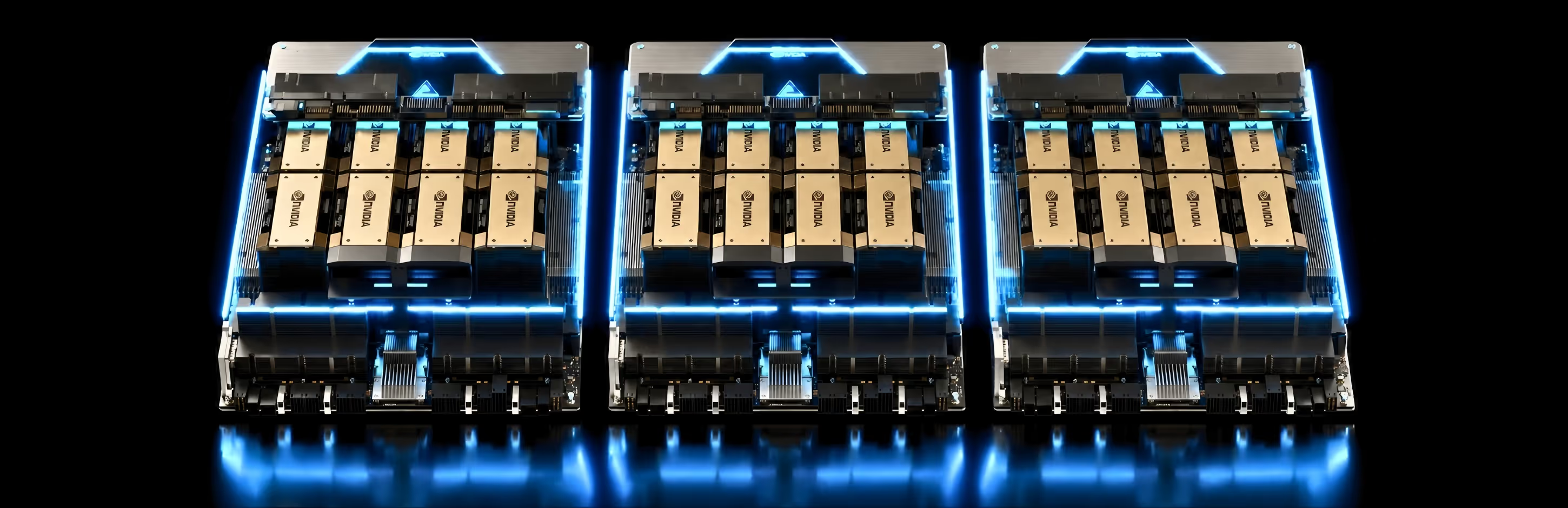
Training large-scale models requires clusters of GPUs capable of performing massive parallel computations. Running production AI workloads requires infrastructure that can deliver consistent performance for inference across distributed environments.
The modern AI stack therefore depends on several critical components:
- High-performance GPU clusters
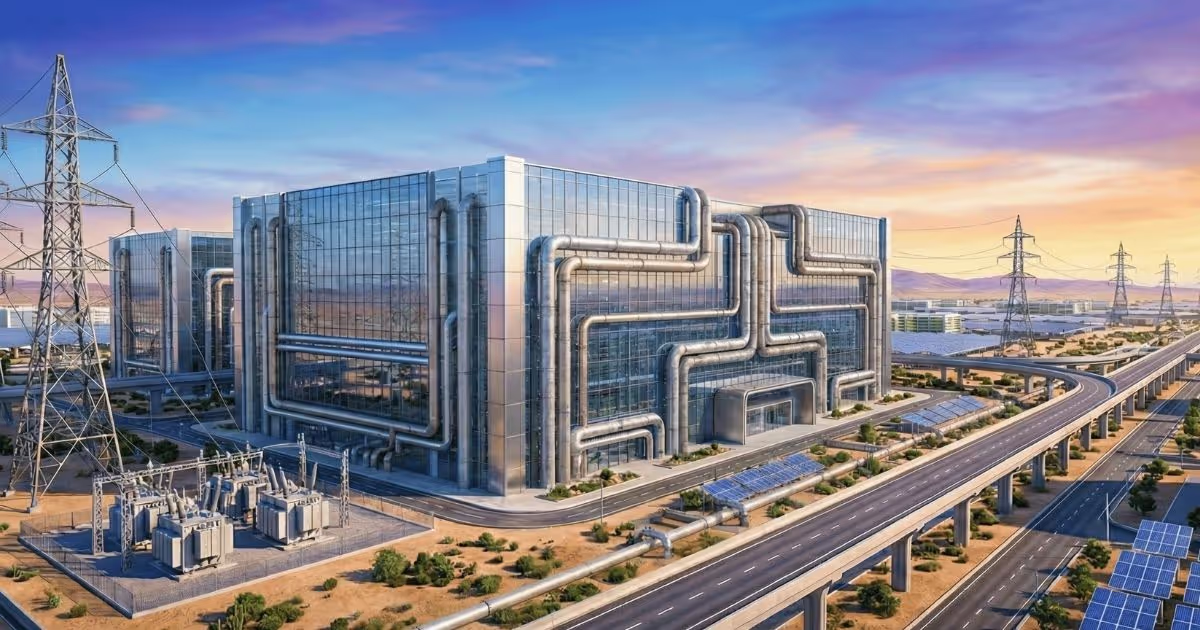
- AI-ready data centers with sufficient power density and cooling
- High-bandwidth networking infrastructure
- Storage systems optimized for large-scale AI workloads
Designing and operating this infrastructure requires significant expertise. Hardware procurement, cluster configuration, data center placement, and workload management all play a role in determining whether infrastructure performs efficiently.
For organizations building AI platforms, access to reliable compute is often the primary operational constraint.
Why Infrastructure Is Attracting Investor Interest
Investing in AI startups can deliver substantial returns, but it also introduces significant uncertainty. Many companies face extremely high training costs, evolving model architectures, and intense competition from well-funded technology firms. Infrastructure investments offer a different exposure to the AI market.
Demand for compute exists regardless of which AI startup ultimately succeeds. Every organization developing AI models requires GPU capacity. Enterprises deploying AI systems require infrastructure capable of supporting large-scale training and inference workloads.
As a result, infrastructure investments can support multiple companies and workloads simultaneously, rather than relying on the success of a single organization.
This strategy resembles earlier technology cycles. During the rise of cloud computing, infrastructure providers became foundational to the entire digital economy. AI infrastructure appears to be following a similar pattern.
For investors, compute capacity represents a way to participate in the growth of AI while reducing exposure to the volatility associated with early-stage software companies.
AI Infrastructure in Practice
A recent deployment illustrates how this investment model works in practice.
HAL 9000, a subsidiary of a private investment group, partnered with Arc Compute to deploy a high-performance GPU cluster across U.S. data centers. Instead of allocating capital to individual AI startups, the organization focused on infrastructure capable of supporting a wide range of AI workloads. For infrastructure leaders exploring similar deployments, read the full case study for a detailed look at how the cluster was deployed and monetized.
The deployment timeline was rapid. The GPU cluster became operational within approximately five days, and compute capacity began generating revenue within 24 hours of activation.
Within days of going live, utilization exceeded 90 percent, demonstrating strong demand for reliable GPU infrastructure from organizations running AI workloads.
This model allowed the investment group to gain exposure to the broader AI market while supporting multiple customers building AI systems.
For infrastructure leaders exploring similar deployments, read the full case study for a detailed look at how the cluster was deployed and monetized.
Infrastructure Economics and Utilization
The economic viability of AI infrastructure depends heavily on utilization rates.
GPU clusters represent a significant capital investment. If infrastructure remains idle, the cost of hardware, power, and data center capacity quickly erodes returns.
Successful infrastructure deployments therefore focus on several key factors:
- Strategic data center placement
- Efficient cluster configuration
- Rapid deployment timelines
- Access to consistent compute demand
When these elements align, infrastructure can support a broad ecosystem of workloads and maintain high utilization levels.
This is why infrastructure operators increasingly focus not only on hardware procurement, but also on deployment strategy and workload access.
The Next Phase of AI Development
The initial phase of the AI boom has been driven primarily by breakthroughs in models and applications. The next phase will likely be defined by infrastructure scalability.
As organizations adopt AI across more functions, demand for compute will continue to grow. Larger models, real-time inference systems, and enterprise AI platforms all require substantial infrastructure capacity.
This is already visible in the expansion of AI data centers, GPU cluster deployments, and specialized infrastructure platforms designed to support AI workloads.
For CTOs and infrastructure leaders, this shift raises important strategic questions around how compute capacity should be sourced, deployed, and managed.
For investors, it highlights the growing importance of infrastructure as a foundational component of the AI economy.
Conclusion
Artificial intelligence may be driven by algorithms and models, but its progress ultimately depends on the infrastructure that powers them.
GPU clusters, AI-ready data centers, and scalable compute platforms are becoming essential components of the modern technology stack. As demand for AI continues to expand, infrastructure will play an increasingly central role in enabling innovation.
For this reason, many investors are beginning to shift their focus from individual AI startups toward the infrastructure that supports the entire ecosystem.
In the long term, the organizations that build and operate the compute layer of AI may prove just as influential as those developing the models themselves.