Fraud detection has crossed a threshold. At global payment scale, financial institutions no longer have minutes to investigate risk. They have milliseconds.
Networks like Mastercard process approximately 165 million transactions per hour, while businesses surveyed by TransUnion report losing an average of 7.7% of annual revenue to fraud, equivalent to $534 billion across respondents. At this scale, fraud prevention is no longer a rules problem or even a model problem. It is an infrastructure problem.
The shift toward graph-based machine learning, real-time inference, and agentic AI workflows has fundamentally changed the compute profile of anti-money laundering (AML) systems. CPU-bound architectures increasingly struggle to meet latency, throughput, and explainability requirements at the same time.
This is why GPU acceleration is becoming non-negotiable for real-time AML and transaction monitoring. It is not an optimization. It is a prerequisite for operating modern fraud stacks at production scale.
The Limits of Rules-Based and CPU-Only Fraud Detection Systems

Traditional fraud detection systems rely heavily on rules engines and sequential processing. These approaches were designed for lower transaction volumes and simpler threat models. Transactions are evaluated largely in isolation, using static thresholds that cannot adapt quickly to new fraud patterns.
As transaction volumes increase and fraud becomes more coordinated, these systems generate excessive false positives while still missing organized fraud rings. Manual review teams become overloaded, operational costs rise, and risk exposure increases.
Machine learning improved detection accuracy but introduced a new constraint: compute latency at scale. As models grow more complex and context-rich, CPU-only infrastructure becomes a bottleneck, particularly when real-time decisioning is required.
From Machine Learning to Agentic AI in AML Platforms
Modern AML platforms are evolving toward agentic AI.
Agentic AI refers to supervised AI agents that orchestrate multi-step AML workflows, including data enrichment, graph traversal, risk scoring, alert prioritization, and case summarization. These systems operate with human-in-the-loop controls, auditability, and policy guardrails to meet regulatory expectations.
This shift dramatically improves investigation speed and consistency, but it also increases computational demand. Agentic workflows require low-latency inference across multiple models and tools, often running in parallel. CPU-based systems struggle to deliver this performance reliably at transaction scale.
Why Graph-Based Fraud Detection Changes the Compute Equation
Fraud does not occur in isolation. It propagates through networks of accounts, devices, merchants, and identities.
Graph analytics and graph neural networks (GNNs) have become central to modern fraud detection, enabling institutions to identify fraud rings, mule networks, and coordinated attacks that linear models cannot detect.
Graph workloads are inherently parallel and memory-intensive. Real-time graph traversal, embedding generation, and inference quickly overwhelm traditional CPU architectures. Once fraud detection becomes graph-native, GPU acceleration becomes essential to meet real-time latency requirements without sacrificing model depth or detection quality.
Real-Time Inference at Transaction Scale
Modern payment networks process tens of thousands of transaction messages per second, while internal systems evaluate far more events, features, and risk signals in parallel.
GPU-accelerated inference enables financial institutions to:
- Score transactions in real time without reducing model complexity
- Run ensemble models and graph ML pipelines concurrently
- Reduce false positives while maintaining high detection accuracy
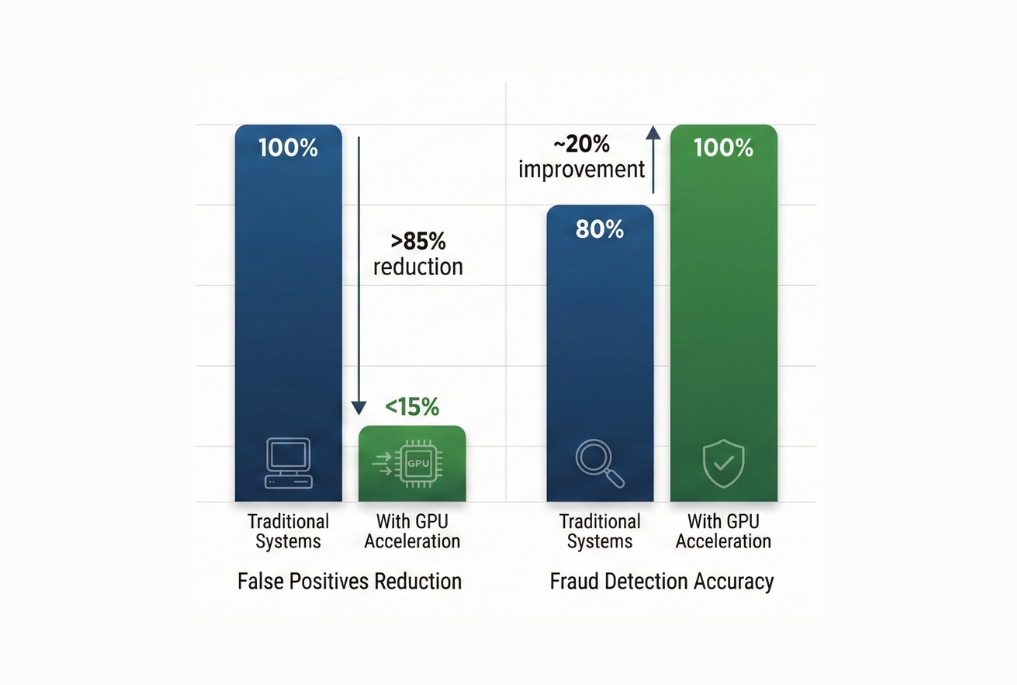
In production deployments, GPU acceleration has enabled:
- More than 85% reduction in false positives
- Approximately 20% improvement in fraud detection accuracy
- Approximately 165 million transactions processed per hour
AML Infrastructure as a Compliance Enabler
AML platforms are not evaluated solely on detection performance. They must also be explainable, auditable, and operationally reliable.
Regulators expect timely monitoring, defensible decisions, and complete audit trails. This pushes AML systems toward always-on inference and continuous monitoring, where latency and system stability directly affect compliance outcomes.
GPU-accelerated infrastructure allows institutions to maintain consistent low-latency performance, generate explanations without delays, and support investigator workflows at scale. In this context, GPUs are not just performance accelerators. They are compliance enablers.
Cloud vs Dedicated GPU Infrastructure for Real-Time AML
Public cloud infrastructure remains valuable for experimentation, model training, and burst capacity. However, always-on real-time AML introduces constraints around latency determinism, data residency, and cost predictability
As a result, many institutions deploy dedicated or single-tenant GPU infrastructure for core AML workloads, while continuing to use cloud resources for development and overflow. This hybrid approach balances flexibility with the performance and reliability required for production transaction monitoring.
The Future of AML Is Compute-Bound
Modern AML systems are being forced to make decisions with incomplete time and infinite context.
That tension is reshaping fraud detection from a modeling challenge into an infrastructure one.
The platforms that succeed will be those designed to sustain real-time graph analysis and continuous inference under production load, not just in controlled benchmarks. This is where infrastructure choices quietly determine outcomes long before alerts ever reach investigators.
At Arc Compute, we work with teams building GPU infrastructure for exactly these conditions, where latency, determinism, and scale are engineered upfront. As AML moves deeper into real-time operation, this foundation becomes less visible but far more decisive.
Ready to scale your fraud infrastructure? Contact our team today to discuss dedicated GPU solutions for Fintech and AML.
Sources
TransUnion: Fraud and Financial Crime Report (H2 2025)
Neo4j: Graph Data Science Use Cases for Fraud and Anomaly Detection
Dell Technologies: AI Empowers Innovative Banks
Mastercard: Decision Intelligence Pro Announcement