Not long ago, CTOs, CIOs, and VP-level leaders were debating whether to adopt liquid cooling for GPU infrastructures supporting high-density AI workloads and training clusters. Today, it’s not a question of if, but when.
A single NVIDIA B200 or B300 server consumes more than 10 kilowatts of power per system. Many legacy data centers were built when 3 to 5 kilowatts per rack was standard. Now, they cannot host even one of these systems.
Next-generation platforms like NVIDIA's Rubin are expected to push rack densities toward 500 kilowatts per rack. At that scale, air cooling becomes not just inefficient, but physically incompatible with modern AI infrastructure requirements.
Let’s break down why liquid-cooled AI infrastructure is becoming a structural requirement for modern GPU environments. We’ll also discuss the operational and financial considerations leaders need to evaluate when planning the transition.
Why Air Cooling Cannot Keep Up With Growing GPU Workloads
GPU systems designed for large-scale AI processing run at sustained high power levels, generating heat at a scale that traditional air-cooled data center infrastructure was never engineered to handle.
Consider the progression: legacy data centers were designed for racks drawing roughly 3 to 10 kilowatts of power.
Today's GPU servers, including platforms like the NVIDIA B200 and B300, draw upwards of 10 kilowatts per server. An NVIDIA GB200 NVL72 rack operates at roughly 120 kilowatts.
The Rubin generation will push beyond 500 kilowatts per rack. As GPU hardware continues to evolve, power density and heat output increase, and air cooling becomes less capable of removing the resulting thermal load.
When servers begin operating at upwards of 10 kilowatts per system, air simply is not efficient enough. The amount of heat that can be removed from a server with air is drastically lower than what can be achieved with liquid cooling.
The physics explain why. Water transports heat far more effectively than air. By volume, it can carry roughly 3,000 times more heat for a similar temperature rise, allowing liquid coolant to remove thermal energy with much higher efficiency.
Most enterprise data centers today cannot support more than two air-cooled GPU servers per rack due to a combination of thermal limits and the sheer physical size of air-cooled designs, which typically run 8U to 10U tall per server. The result is a practical ceiling on what air-cooled AI infrastructure can deliver.
This is not a theoretical future concern, but a constraint that organizations are running into today with hardware that is already shipping.
The Benefits of Liquid Cooling for GPU Infrastructure
The case for GPU liquid cooling is built on five compounding advantages. Together, they reframe liquid cooling not as a premium option but as the more rational infrastructure decision for any serious AI deployment.
1. Dramatic Increase in GPU Rack Density
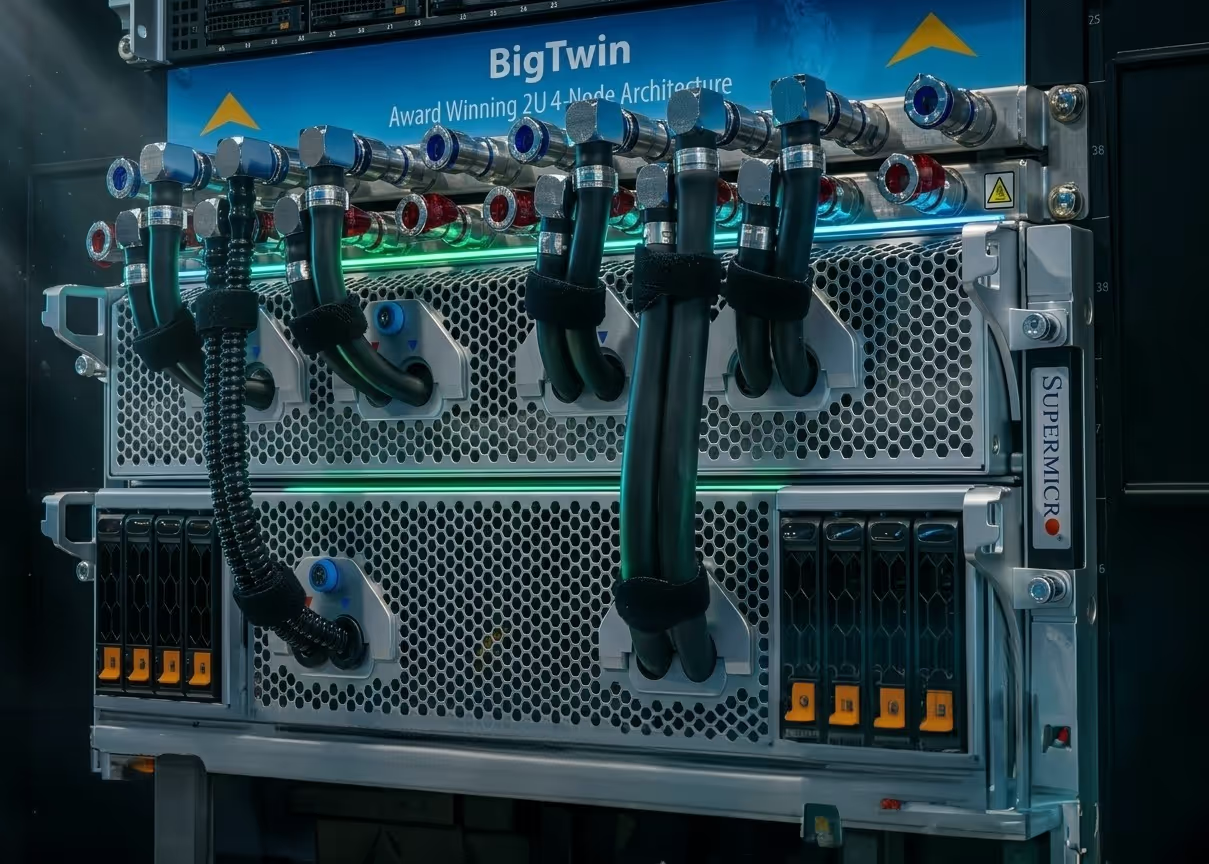
Liquid-cooled GPU servers are physically smaller (typically 4U compared to 8U to 10U for equivalent air-cooled designs) and thermally dense enough to fully fill a rack.
Where an air-cooled facility might support one to two GPU servers per rack due to thermal and physical constraints, a liquid-cooled environment can support four to eight, and sometimes more, depending on rack power capacity.
In real-world cluster terms: a 144-node GPU cluster that requires 72 air-cooled racks can be deployed in just 18 liquid-cooled racks. That is the same compute capacity in one-quarter of the physical footprint.
At a time when U.S. data center capacity is running at approximately 97 percent utilization, density is not a nice-to-have. It is a strategic asset.
4× reduction in rack count for equivalent compute
2. Lower Cabling Costs and Fewer Network Failures
Rack density has a downstream effect that is easy to overlook in the early planning stages. It determines your cabling architecture, and your cabling architecture determines your cluster reliability.
When a 144-node cluster is spread across 72 racks, inter-rack cable runs extend far beyond the practical limit of five to seven feet for direct-attach copper (DAC) and active optical copper (AOC) cables. At that scale, the network must use fiber and optics.
Optics are expensive. They also fail at a meaningfully higher rate than copper alternatives. Those failures do not just trigger a support ticket. They interrupt active training runs, waste compute hours, and add operational overhead.
Consolidating that same cluster into 18 liquid-cooled racks brings nearly all inter-GPU connections within DAC/AOC range.
This one architectural shift eliminates a category of hardware failure and significantly reduces cabling spend, a benefit that persists and compounds over the cluster's operational lifetime.
3. Greater Thermal Stability and Hardware Reliability
Liquid cooling maintains more consistent component temperatures than air, particularly during the sustained high-utilization workloads that define AI training.
Stable temperatures mean fewer thermal stress cycles, which translates directly to lower hardware failure rates and longer GPU lifespans.
For organizations running continuous training jobs, the math on reliability is unforgiving. An unplanned hardware failure does not just pause a job. It can invalidate hours or days of compute progress, require checkpoint recovery, and delay project timelines.
Liquid cooling reduces that risk category in a way that better air conditioning simply cannot replicate.
4. Superior Energy Efficiency
Liquid-cooled data centers consistently achieve Power Usage Effectiveness (PUE) ratings below 1.2. Air-cooled facilities typically range from 1.4 to 1.6.
That gap, though seemingly small in percentage terms, represents a substantial difference in operating cost at the scale of a modern, continuously running GPU cluster.
More efficient cooling also means more of the power drawn by a facility is going to actual compute rather than thermal management infrastructure.
For AI labs and cloud providers optimizing for cost per GPU-hour, this increase in efficiency directly affects the economics of every workload.
5. Scalability Without the Floor Space Constraint
Air-cooled GPU clusters face two scaling limits: thermal capacity and physical space.
As clusters grow, so does the floor space required to support additional racks. In a market where enterprise data center capacity is near saturation, floor space is scarce and expensive.
Liquid cooling's density advantage reduces the physical space required for GPU clusters. Organizations can expand compute capacity within the same physical footprint, without competing for new colocation space or financing additional facilities.
That flexibility has measurable strategic value as AI workloads grow and cluster scale requirements increase.
The Tradeoffs: What Leaders Need to Plan Before Adopting Liquid Cooling
Liquid cooling is not a plug-and-play upgrade, and infrastructure leaders who approach it as one will run into planning failures. The tradeoffs just require strategic evaluation.
Installation requires specialist expertise. Water in a data center is not a DIY project. Routing coolant lines, managing pressure systems, implementing leak detection, and validating the full installation requires professional infrastructure teams. This is a baseline requirement, not an optional service tier.
An average build takes months to complete. Converting an existing facility to support liquid cooling typically takes six to eight months at a minimum. Building a purpose-built liquid-cooled data center from the ground up takes two years.
Even converting an industrial warehouse to a liquid-cooled data center can take six months at minimum using modular infrastructure, assuming the required power is available at the selected site.
That means organizations evaluating liquid cooling in response to an immediate capacity need are likely already behind schedule.
Upfront capital is higher, but total cost often is not. Building liquid-cooled infrastructure costs more than equivalent air-cooled construction.
However, the total cost of ownership calculation changes significantly at the cluster level. Liquid-cooled colocation charges more per rack, but the reduction in rack count means total facility spend is often comparable or lower than an air-cooled equivalent for the same compute.
The right unit of analysis is cost per GPU versus cost per rack.
These are planning considerations that require early evaluation. The organizations running liquid-cooled AI infrastructure competitively today started those facility conversations twelve to eighteen months ago.
How NVIDIA's GPU Roadmap Is Driving the Shift to Liquid Cooling
NVIDIA's hardware roadmap has effectively made the industry’s decision: liquid cooling is moving from an option to a requirement.
Rubin, NVIDIA's next-generation GPU platform, is architected for liquid cooling. Running Rubin-class hardware in an air-cooled environment is not a thermal management challenge, but an impossibility.
The same trajectory is visible at the network layer. The engineering limit for switch ports is roughly 20 watts per port, and optics operating above that threshold tend to fail rapidly in air-cooled environments.
NVIDIA has already launched a closed-loop liquid-cooled switch to address this. Other vendors are expected to follow.
The market data confirms the trajectory. The global liquid cooling market was valued at approximately $4.7 billion in 2025 and is projected to reach $21 billion by 2032, a compound annual growth rate exceeding 30 percent.
Every major hyperscaler has committed liquid cooling as the default for new AI infrastructure. Microsoft, Google, AWS, Meta, and CoreWeave are all building or converting at scale.
For enterprise AI labs, cloud infrastructure teams, and VP-level decision-makers, the practical implication is clear: organizations that plan their infrastructure around liquid cooling now will have compatibility with next-generation GPU platforms. Those that do not will face a forced transition on a compressed timeline with fewer options.
The Bottom Line
There are significant GPU liquid cooling benefits: four to eight times higher rack density, lower cabling costs and failure rates, improved hardware reliability, better energy efficiency, and forward compatibility with next-generation GPU platforms that air cooling cannot support at all.
The tradeoffs include longer build timelines, higher upfront capital, and the need for specialist installation.
But organizations that take liquid cooling seriously now are building the infrastructure foundation for the AI compute they will need in 2026, 2027, and beyond. Those that treat it as a future concern may find that the future arrives before the facility is ready.
The physics, the GPU roadmap, and the market have converged on the same answer. Liquid-cooled AI infrastructure is no longer optional for facilities planning the next generation of AI compute.
Planning the Transition to Liquid-Cooled AI Infrastructure
As organizations rethink how to deploy and scale GPU infrastructure, the transition to liquid-cooled environments requires both hardware expertise and infrastructure strategy. At Arc Compute, we work with AI labs, cloud providers, and enterprise infrastructure teams to design GPU environments that are ready for next-generation platforms, from today’s high-density clusters to the architectures coming next. That means helping teams evaluate power density, cooling architecture, and system design so their infrastructure decisions today remain compatible with the compute demands of tomorrow.