Even two or three decades ago, high frequency trading was already one of the most technologically advanced and competitive frontiers in finance. Today, it has only become more competitive as AI native strategies grow more widespread and accessible. With tools that lower the barrier to entry and a market that evolves in microseconds, firms must now excel in two disciplines at once: absolute speed and advanced intelligence. To compete effectively, trading organizations must design infrastructure that delivers both, and GPUs have become central to making that possible.

How High Frequency Trading Works Today
HFT is often described as fast trading, but speed is only one piece. Modern strategies combine three capabilities:
- Ultra low latency, reacting to market data in microseconds
- Massive parallel analysis, processing thousands of signals simultaneously
- Real time model adaptation, adjusting strategies dynamically as liquidity regimes change
Firms ingest tick level data from many venues, simulate short term price dislocations, evaluate micro patterns within the order book, and route orders through optimized execution paths.
This requires computing infrastructure that can:
- Run thousands of Monte Carlo paths in parallel
- Recalculate fair value models instantly
- Analyze full order book depth without bottlenecks
- Update model parameters intraday
- Execute inference with minimal jitter
For years, this workload relied heavily on overclocked CPUs and FPGAs. CPUs offered flexibility. FPGAs offered deterministic latency.
But today’s trading is not only about reacting faster. It is about thinking faster. This shift has pushed GPUs to the forefront.
Why GPUs are Now Essential in HFT
GPUs were once seen as suitable only for overnight risk calculations, too slow for live trading. That is no longer true.
Modern GPU architectures, improvements in CUDA software, and networking technologies now allow GPUs to operate within the ultra low latency envelope required for production trading systems, while providing thousands of cores for massive parallel computation.
1. Parallelism for Strategy Development
Back testing, reinforcement learning experiments, and market simulation all benefit from GPUs and their ability to run thousands of simulations at once.
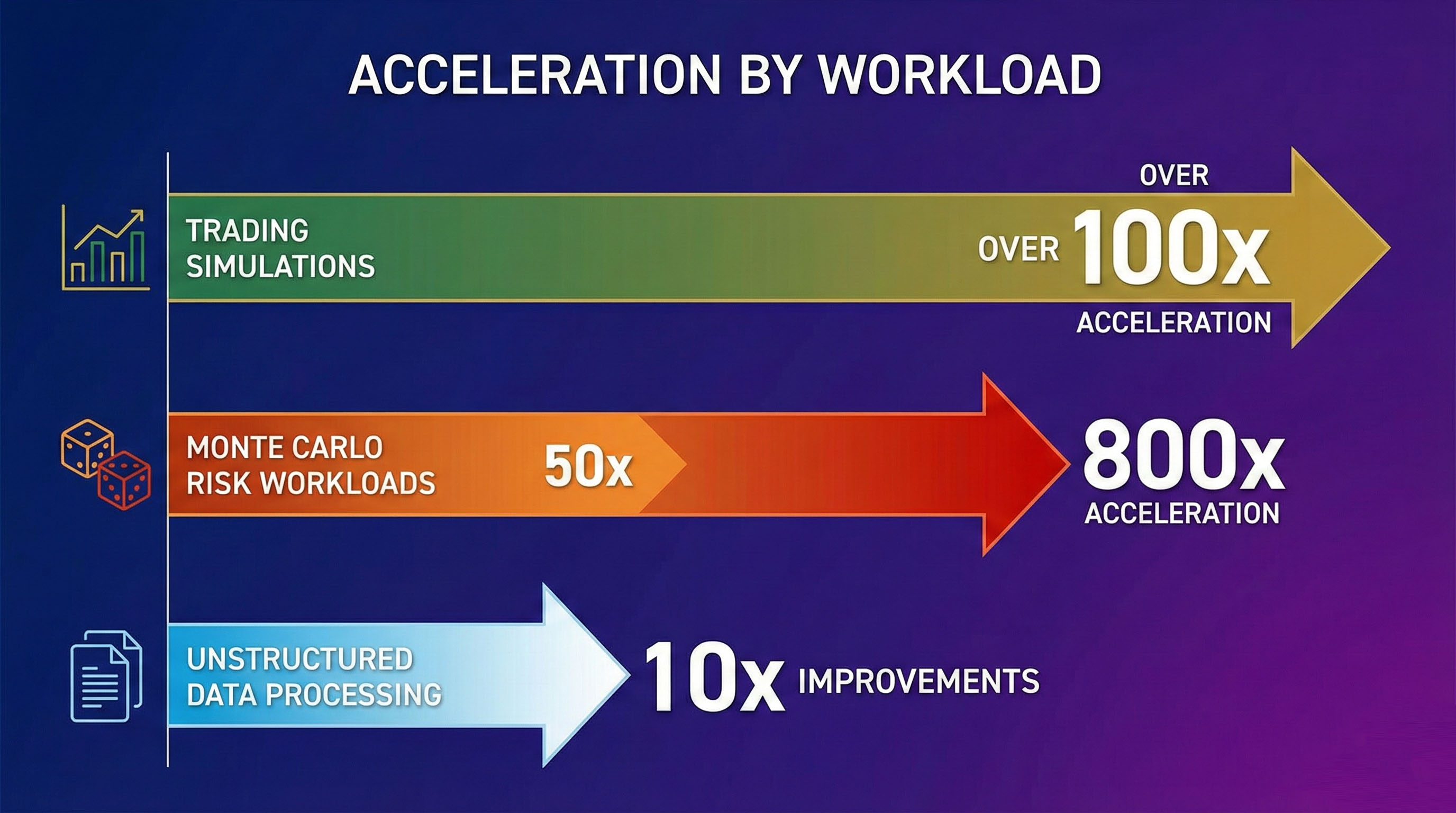
Benchmarks show:
- Over 100 times acceleration for trading simulations
- 50 to 800 times acceleration for Monte Carlo risk workloads
- 10 times improvements in unstructured data processing
This speed does more than make analysis faster. It changes the scale of what is possible. Firms can simulate years of intraday data in hours, train reinforcement learning modules on many synthetic market scenarios, and explore model variants that would be impractical on CPUs.
2. Low Latency Inference for Live Markets
Modern HFT increasingly relies on machine learning inference, including short term direction prediction, liquidity shifts, and volatility forecasts.
GPUs now deliver inference latencies in the double digit microseconds, fast enough for many latency sensitive strategies. Techniques such as persistent CUDA kernels, CUDA Graphs, and GPUDirect RDMA have eliminated much of the overhead that previously made GPUs unsuitable for live execution.
3. Speed and Intelligence Now Matter More Than Ever
Networking has pushed physical latency closer to theoretical limits, and shaving off microseconds remains just as critical today as it has always been. At the same time, modern trading requires extracting far more intelligence from the same tiny time window. Firms must excel at both. AI driven research workflows, richer feature extraction, larger context windows, and dynamic decision logic all benefit from the parallelism GPUs provide. While the most latency critical paths still rely on deterministic execution, many firms now combine fast models with fast execution, integrating adaptive AI techniques in the research and development cycle and in certain execution layers outside the nanosecond loop. As more AI native tools lower the barrier to entry for new participants, competitive firms must optimize both raw speed and advanced intelligence to stay ahead
What Leading Trading Firms Are Doing
Across the industry, one theme is clear. Top tier trading firms are now deeply GPU centric.
- Large market making firms use GPU accelerated infrastructure for large scale simulation, reinforcement learning, and quantitative research.
- Banks with advanced AI research labs train transformer models and reinforcement learning execution engines on multi GPU clusters, reducing research cycles from many months to a few weeks.
- Proprietary trading firms deploy GPU servers in colocation centers for real time analytics and low latency inference.
Even smaller quant shops use hybrid architectures. FPGAs handle the critical nanosecond loop. GPUs handle signal generation, simulation, research workloads, and real time risk. The result is a new market reality. Competitive edge now depends on who understands the data fastest, not only on who receives it first.
The Infrastructure Challenge: Cloud vs. Bare Metal
Public cloud is appropriate for experimentation and elastic research workloads. It breaks down in production trading.
HFT workloads suffer from:
- Jitter caused by noisy neighbors
- Virtualization overhead
- Unpredictable cross region latency
- High costs for continuous GPU use
As soon as real time inference or continuous simulation enters the workflow, the cloud becomes both economically and technically limiting. For this reason, the industry is returning to dedicated, bare metal GPU infrastructure that provides deterministic performance.
Case in Point: Lynx Trading Technologies
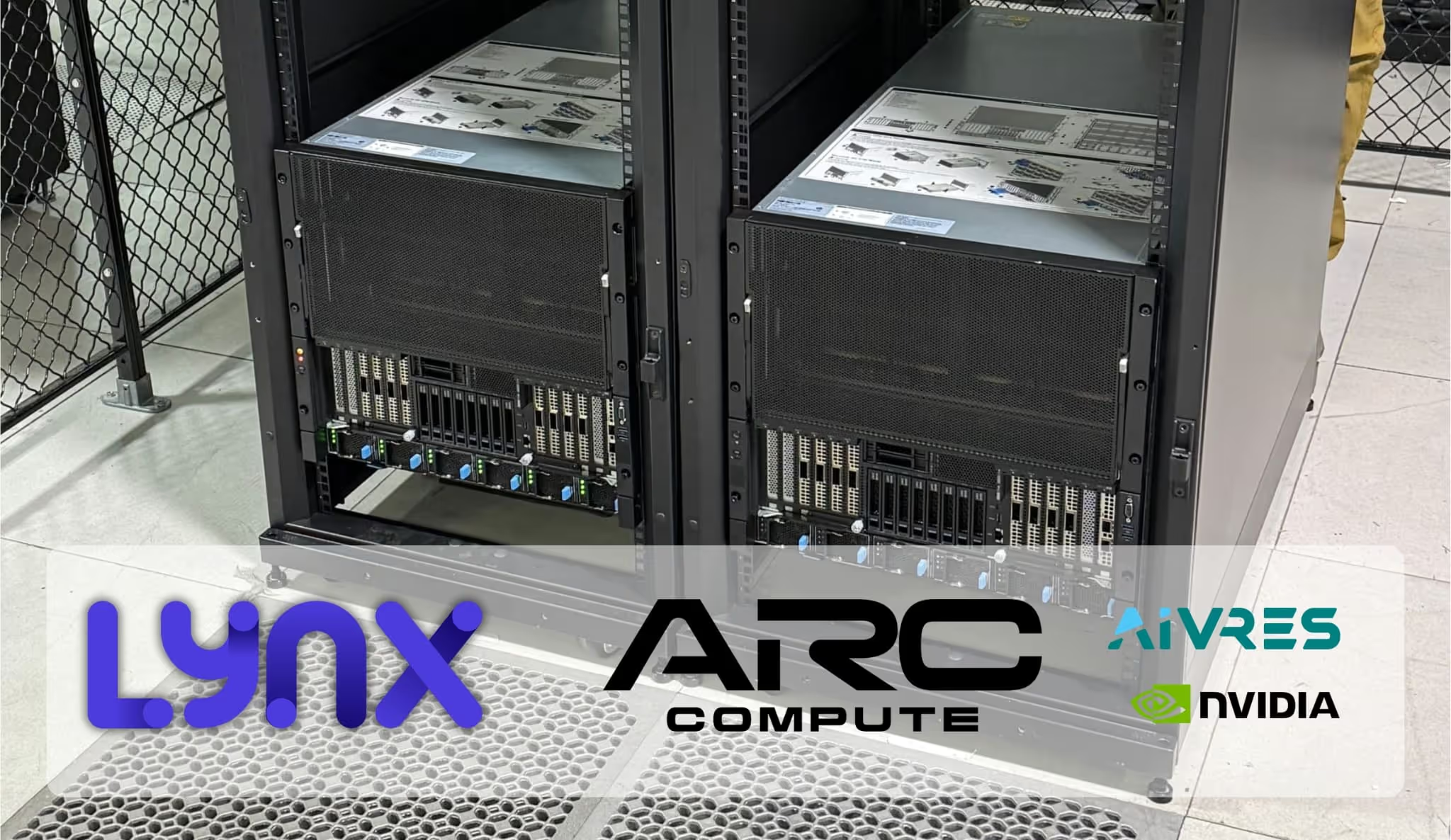
Lynx, a proprietary trading firm, migrated from the public cloud to Arc Compute’s on premise NVIDIA HGX B200 systems. Within four weeks, they:
- Eliminated cloud induced jitter
- Gained full transparency and control over tuning
- Reduced long term compute costs
- Improved real time analytics performance
This shift allowed their quantitative team to run larger models, faster back tests, and more stable real time signals. They achieved this without unpredictable performance variation or growing cloud bills.
Their experience reflects a broader industry trend. Firms that need real time intelligence must own the metal. Read the full case study here.
How Arc Compute Powers the Next Generation of Trading
Modern HFT requires infrastructure that delivers deterministic latency together with high intelligence throughput. Arc Compute specializes in delivering purpose built GPU infrastructure for trading, quantitative research, and risk analytics.
Our systems are optimized for:
- Real time model inference
- Parallel strategy simulation
- Deep learning pipelines
- Hybrid reinforcement learning workflows
- Monte Carlo analytics
- Data intensive quantitative research
Our server portfolio includes the latest NVIDIA HGX platforms (i.e HGX B300s) with high bandwidth HBM3e memory, advanced NVLink interconnects, and high-speed networking options. These are designed specifically for firms that cannot tolerate jitter, downtime, or capacity ceilings. We can also build the right AI architecture with other new technologies like the RTX Pro 6000s and more.
Whether deployed on premises, in colocation, or as part of a hybrid model, Arc provides:
- Predictable performance
- Dedicated, single tenant environments
- Infrastructure tuned for financial microstructure
- End to end consultation from sizing to deployment
In today’s markets, compute power is competitive advantage. Firms that modernize their infrastructure now, and treat GPU acceleration as foundational rather than optional, will define the next decade of trading.